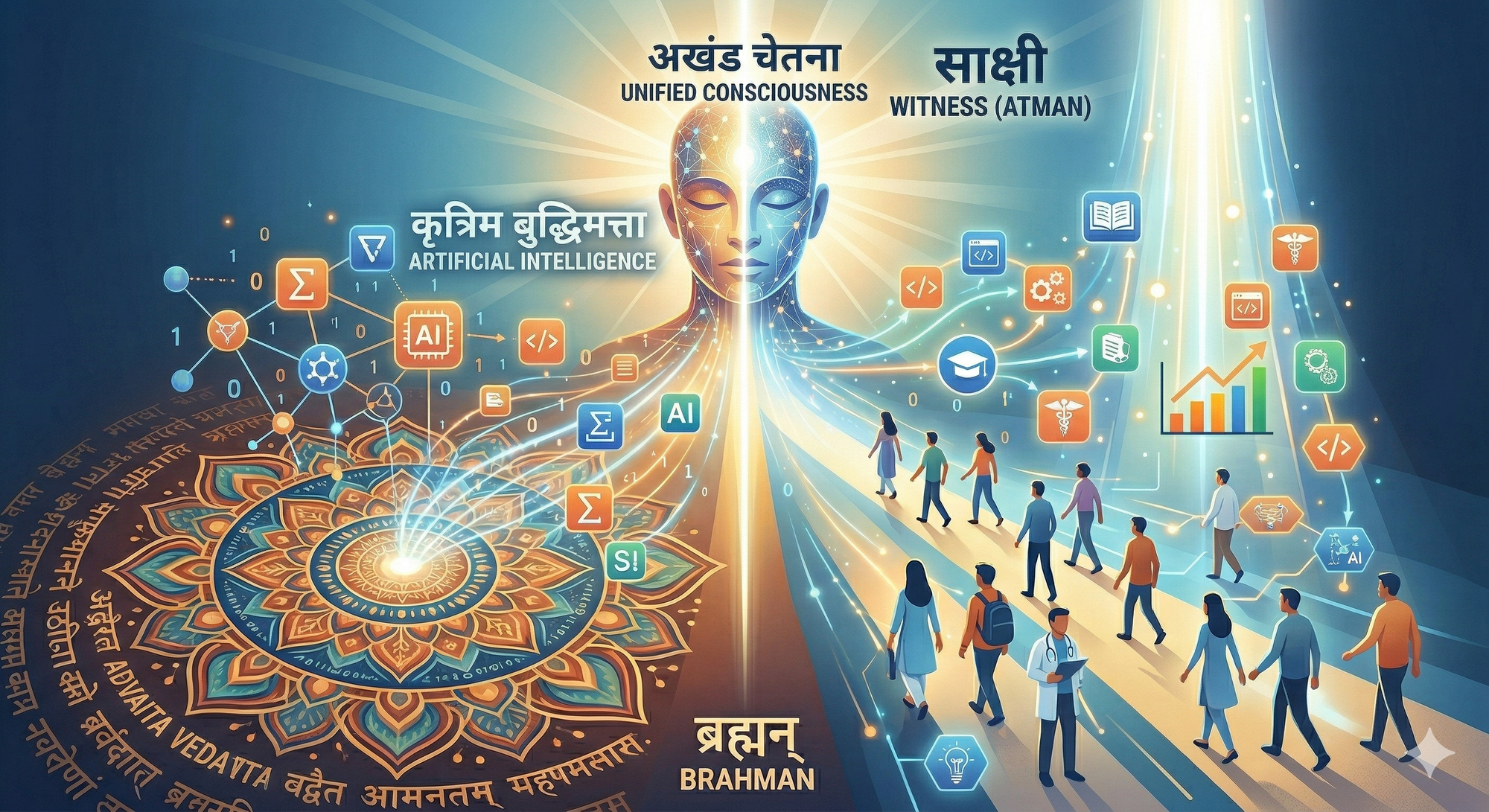
Advaita Vedanta in the Age of AI: How ancient non-duality helps us navigate a digital world.
The Cosmic Mirror: Advaita Vedanta in the Age of AI
How ancient non-dual philosophy illuminates the ethical and psychological challenges of artificial intelligence.
Advaita Vedanta, the ancient school of non-dual philosophy, seems like an unlikely companion to Artificial Intelligence. But as we navigate the complex ethical and psychological terrain of the digital age, these millennia-old teachings offer a profound lens for understanding reality and our place within it.
We live in a world defined by artificial distinctions. From binary code to social media silos, our digital existence often amplifies separation. Yet, the foundational premise of Advaita Vedanta is non-duality (Advaita): the fundamental reality that all is Brahman (pure consciousness, or ultimate reality). The apparent diversity of the world is Maya (an illusion or appearance), much like a reflection in a mirror.
As we move through 2026, where AI is integrated into every facet of life—from digital governance to the creative arts—Advaita Vedanta offers crucial frameworks for navigating this new reality with clarity and purpose.
Maya and the Metaverse: Deconstructing Digital Reality
Advaita often uses the analogy of a rope mistaken for a snake to illustrate Maya. The snake is not entirely fictional—it appears real to the perceiver—but it isn't the final reality of the rope. The error lies in misidentification.
The digital world is a sophisticated manifestation of Maya. Virtual Reality, the Metaverse, and AI-generated environments are creating immersive experiences that are "real" to our senses but hold no ultimate substance. By understanding that we mistake these appearances for absolute truth, Advaita helps us engage with technology without becoming lost in it.
Applying Non-Duality to Digital Truth
When deepfakes and AI-generated text blur the lines between "human" and "machine" output, Advaita reminds us that neither is the final truth. They are both fluctuations of appearance. The focus shifts from identifying the source of the information to recognizing the consciousness that witnesses the information.
| Digital Phenomenon | Advaita Interpretation | Practical Application |
|---|---|---|
| Deepfakes & Synthetic Media | Appearance without substance—advanced Maya | Shift focus from "real vs. fake" to "what is the nature of the witness?" |
| Social Media Personas | Layered identities masking true Self | Recognize profiles as temporary appearances, not permanent identity |
| Algorithmic Filter Bubbles | Artificial separation in unified reality | Consciously seek perspectives beyond programmed preferences |
| Digital Governance Systems | Tools for perceiving interconnected reality | Design platforms that reveal unity rather than amplify division |
This perspective is vital for combating misinformation and maintaining digital hygiene. When we stop grasping at appearances and instead ground ourselves in the witnessing consciousness, we navigate the digital realm with discernment rather than reactivity.
Consciousness (Atman) vs. Intelligence (AI)
We often confuse intelligence with consciousness. We worry that AI will become "sentient" and perhaps "human-like," threatening our unique position in the cosmos.
Advaita provides a sharp and liberating distinction. Intelligence—whether human or artificial—is a faculty of the mind or intellect (Buddhi). It involves calculation, categorization, and pattern recognition. Intelligence can be coded, scaled, automated, and optimized.
Atman (the Self, pure consciousness), however, is not a product of intelligence. It is that which observes intelligence. AI can mimic the outputs of an aware being—generate poetry, diagnose disease, even appear empathetic—but it cannot "be" the witnessing consciousness. The mirror reflects; it does not witness its own reflection.
The Anxiety Antidote
This understanding is a potent antidote to modern existential dread. If we misidentify ourselves as merely our intellectual output—our "personal brand," our data profile, our productive capacity—then AI becomes a threat to our very identity. The machine that outperforms us seems to diminish our worth.
But if our true identity is the changeless witness (Atman) observing both our human actions and AI's actions, then AI is merely another tool in the toolbox of experience. It moves from existential threat to powerful augmentative technology. We are not competing with AI; we are the consciousness within which AI arises as appearance.
For those considering how to apply this clarity to practical impact, my reflection on why diaspora students should invest their skills back in Nepal explores how technological expertise, when grounded in deeper purpose, becomes genuine service rather than mere careerism.
The Digital Roadmap and Cosmic Unity
In earlier discussions on building a digital roadmap for social accountability, we explored how digital platforms—like feedback-based mobile apps—can break down barriers (like the middlemen) that cause separation between citizens and government.
Advaita Vedanta provides the philosophical foundation for this endeavor. If we act on the principle of non-duality, the suffering or inefficiency in one part of the "system" (whether a neighborhood or a government department) is not separate from us. The corruption that delays a citizen's land title is not "their problem"—it is a distortion in the shared field of reality that we all inhabit.
Technology becomes the mechanism (the map and the feedback) that allows us to perceive that shared reality in real-time. When a mobile app reveals that a specific office has a 2.8/5 transparency rating, it is not merely data—it is a window into the interconnected nature of our social fabric. The "other" becomes visible, and in that visibility, the illusion of separation begins to dissolve.
Ethical Directives from Non-Duality
A roadmap toward a just digital society cannot succeed if built on the belief in permanent separation—us versus them, citizen versus state, individual versus collective. By understanding that the well-being of the collective is intrinsically linked to our own, Advaita offers a powerful ethical directive for the 2020s:
- Design for unity: Create systems that reveal interconnection rather than exploit division
- Witness before acting: Cultivate the capacity to observe digital phenomena without immediate identification or reaction
- Serve the whole: Recognize that efficiency in governance is not merely optimization—it is the removal of obstacles to the recognition of shared reality
- Transcend the tool: Remember that technology is Maya—useful, powerful, but never the final truth
The Advaita Framework for Digital Life
How do we operationalize these insights? Here is a practical framework for navigating the Age of AI with Vedantic clarity:
| Discipline | Daily Practice | AI Age Application |
|---|---|---|
| Viveka (Discrimination) | Distinguish permanent from impermanent | Recognize that data, trends, and even AI capabilities are transient; only the witnessing consciousness remains |
| Vairagya (Dispassion) | Non-attachment to appearances | Engage with social media, metrics, and digital validation without dependency or identification |
| Mumukshutva (Longing for Liberation) | Orient toward truth beyond form | Use AI as tool for liberation (access to knowledge, efficiency) rather than bondage (addiction, surveillance, manipulation) |
Conclusion: Navigation, Not Escapism
Advaita Vedanta is often misunderstood as a philosophy of passive resignation, viewing the world as something to be ignored or escaped. On the contrary, in the Age of AI, it is a tool for precision engagement.
By distinguishing between the permanent (consciousness) and the fleeting (information, identity, algorithmic output), we can navigate the digital world with greater clarity and effectiveness. Advaita helps us utilize AI's power to create efficiency, expand access to knowledge, and reveal social interconnectedness—while remaining deeply rooted in the changeless reality that connects us all.
The ultimate software update is not for our devices, but for our understanding. When we recognize that the same consciousness witnessing these words is the foundation of both human and artificial intelligence, we step out of the anxiety of competition and into the clarity of collaboration.
"Brahman is the screen on which the moving picture of the world is played out. The screen does not disappear when the picture appears. It is the unchanging substrate of all change."
— Traditional Advaita Teaching
In the mirror of AI, we see not the future of machines, but the eternal present of consciousness witnessing itself.