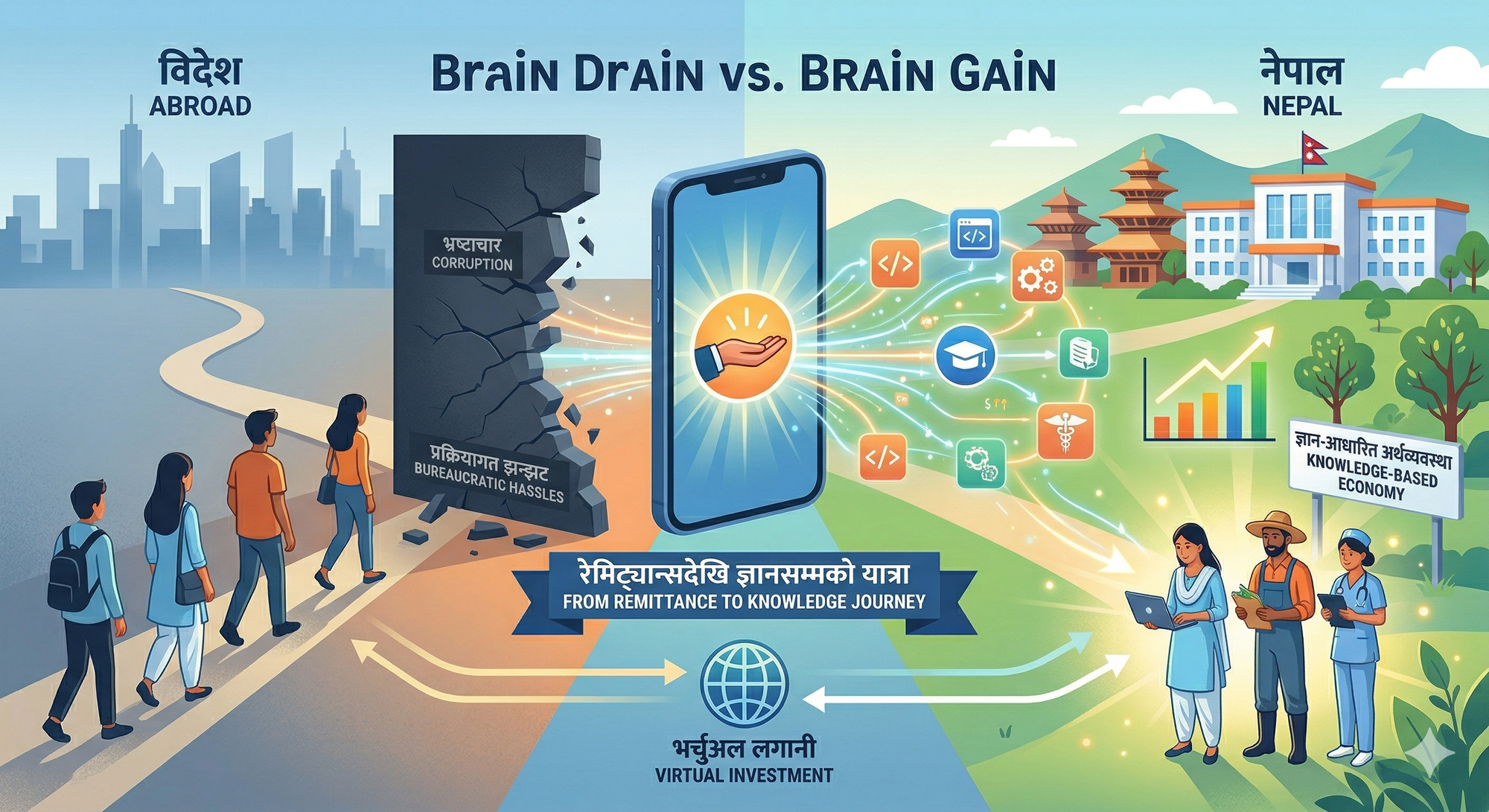
Brain Drain vs. Brain Gain: A personal perspective on why diaspora students should invest their skills back in Nepal
Turning departure into return: How Nepal's global diaspora can drive the next decade of national development.
For decades, the narrative of Nepal's youth has been one of departure. We see it in the long queues at Tribhuvan International Airport and feel it in the quiet streets of our villages. This phenomenon, often labeled "Brain Drain," has long been viewed as a loss of our most productive human capital.
But as we move through 2026, the tide is turning. For those of us studying and working abroad, the question is no longer just "How do I succeed out here?" but "How do I bring that success back home?"
The Shift: Why "Brain Gain" is the New Reality
"Brain Gain" isn't just a buzzword; it's a strategic reinvestment. While remittances have historically sustained our economy, they are a short-term fix. True national growth requires the repatriation of skills, networks, and global standards.
1. Bridging the Technology Gap
The Nepali IT sector recently crossed the $1 billion mark in exports, driven largely by diaspora-led startups and returnees. By investing skills in AI, automation, and software development, we aren't just filling jobs—we are building the infrastructure for a digital Nepal.
See my previous post on how feedback-based mobile apps can curb corruption to understand how we can apply these tech skills to governance.
2. Implementing Global Best Practices
Living abroad exposes us to systems that work—from efficient healthcare to transparent public administration. When a diaspora student returns, they bring a "mental blueprint" of efficiency that can dismantle the "middleman culture" currently hindering our progress.
3. Economic Multiplier Effect
A single returning professional often becomes an entrepreneur. By starting a business in Nepal, you don't just "gain" a job for yourself; you create a dozen more for those who didn't have the chance to go abroad.
Barriers to Return: Addressing the Elephant in the Room
We cannot ignore why people stay away. Political instability and bureaucratic "red tape" are real hurdles. However, the 2026 landscape is different. With Nepal graduating from Least Developed Country (LDC) status this year, there is a renewed focus on "Ease of Doing Business" and digital governance.
| Traditional Barrier | 2026 Opportunity | Diaspora Role |
|---|---|---|
| Bureaucratic red tape | Digital governance initiatives | Tech expertise for system design |
| Political instability | LDC graduation momentum | Policy advocacy from neutral ground |
| Limited local investment | Startup ecosystem growth | Venture capital & mentorship |
| Skills mismatch | IT sector $1B export milestone | Direct skills transfer & training |
How You Can Invest (Even from Afar)
You don't always need to buy a one-way ticket back to Kathmandu to contribute. "Brain Circulation" allows for continuous engagement without permanent relocation:
- Virtual Mentorship: Guiding students at local institutes like VIT or IOE through structured online programs, connecting classroom learning with industry realities
- Remote Investment: Funding local startups that align with your expertise, from fintech to agrotech, with due diligence support from diaspora networks
- Policy Advocacy: Using digital platforms to push for the reforms we see working abroad—transparency standards, procurement reform, digital identity systems
My thoughts on the People's Roadmap initiative highlight how digital engagement from the diaspora can shape national policy.
The "Remote Returnee" Model
Modern connectivity enables a hybrid model where diaspora professionals contribute without full relocation:
| Engagement Level | Time Commitment | Impact Potential | Examples |
|---|---|---|---|
| Remote Advisory | 2-5 hrs/week | Moderate | Virtual mentoring, code reviews, curriculum design |
| Project-Based | Seasonal intensive | High | 3-month startup acceleration, policy drafting sprints |
| Rotational | 6 months/year | Very High | Split-time CTO roles, academic exchange programs |
| Full Return | Permanent | Transformative | Entrepreneurship, institutional leadership, politics |
Priority Sectors for Diaspora Investment
Not all sectors offer equal opportunity for brain gain impact. Based on Nepal's 2026 development priorities, these domains present the highest leverage:
Digital Governance & Civic Tech
Building on initiatives like the citizen feedback platform, diaspora tech talent can design systems that reduce corruption, streamline service delivery, and create transparency. Skills needed: UX design, data science, cybersecurity, blockchain verification.
Climate Tech & Green Energy
Nepal's hydropower potential remains underoptimized. Diaspora engineers and environmental scientists can bridge the gap between potential and implementation, bringing project finance expertise and modern grid management knowledge.
Health Tech & Medical Tourism
Post-pandemic healthcare digitization offers opportunity. Diaspora medical professionals can design telemedicine platforms, establish diagnostic standards, and create medical tourism infrastructure that leverages Nepal's cost advantages.
Agrotech & Food Security
With 66% of the population in agriculture, productivity gains here have massive multiplier effects. Precision farming, supply chain optimization, and market linkage platforms need diaspora expertise in IoT, logistics, and data analytics.
Emerging Models: Brain Gain in Action
The transition from drain to gain is already visible among early movers:
| Archetype | Background | Nepal Venture | Impact |
|---|---|---|---|
| The Tech Founder | Silicon Valley engineer, 8 years experience | AI-powered logistics startup | 120 jobs created, $2M annual exports |
| The Policy Returnee | Australian public servant, digital transformation unit | Advisory role in provincial digital governance | 3 districts digitized, processing time -60% |
| The Academic Bridge | UK professor, renewable energy systems | Research partnership with Pulchowk Engineering | 12 joint publications, 2 patent applications |
| The Remote Investor | Dubai-based finance professional | Angel network for Nepali fintech startups | $500K deployed, 8 companies funded |
Final Perspective: The Moral of the Story
Nepal doesn't need our sympathy; it needs our expertise. The "struggle" we face as students in Melbourne, London, or New York has equipped us with a resilience that is exactly what Nepal needs to leapfrog into the next decade of development.
The transition from a "remittance-based economy" to a "knowledge-based economy" starts with us. It's time to stop viewing our departure as a loss and start viewing it as a global internship for a better Nepal.
The Brain Gain Commitment Framework
Consider this your personal roadmap from observer to participant:
- Inventory your skills: What expertise do you have that Nepal lacks?
- Map the gap: Where exactly could this skill create value—specific sector, specific institution?
- Start remote: Begin with mentorship, advisory, or investment before full return
- Build networks: Connect with other diaspora professionals in your field
- Plan the transition: Set a timeline for physical or substantial virtual return
What specific skill do you think is most needed in Nepal right now—and are you ready to share it?