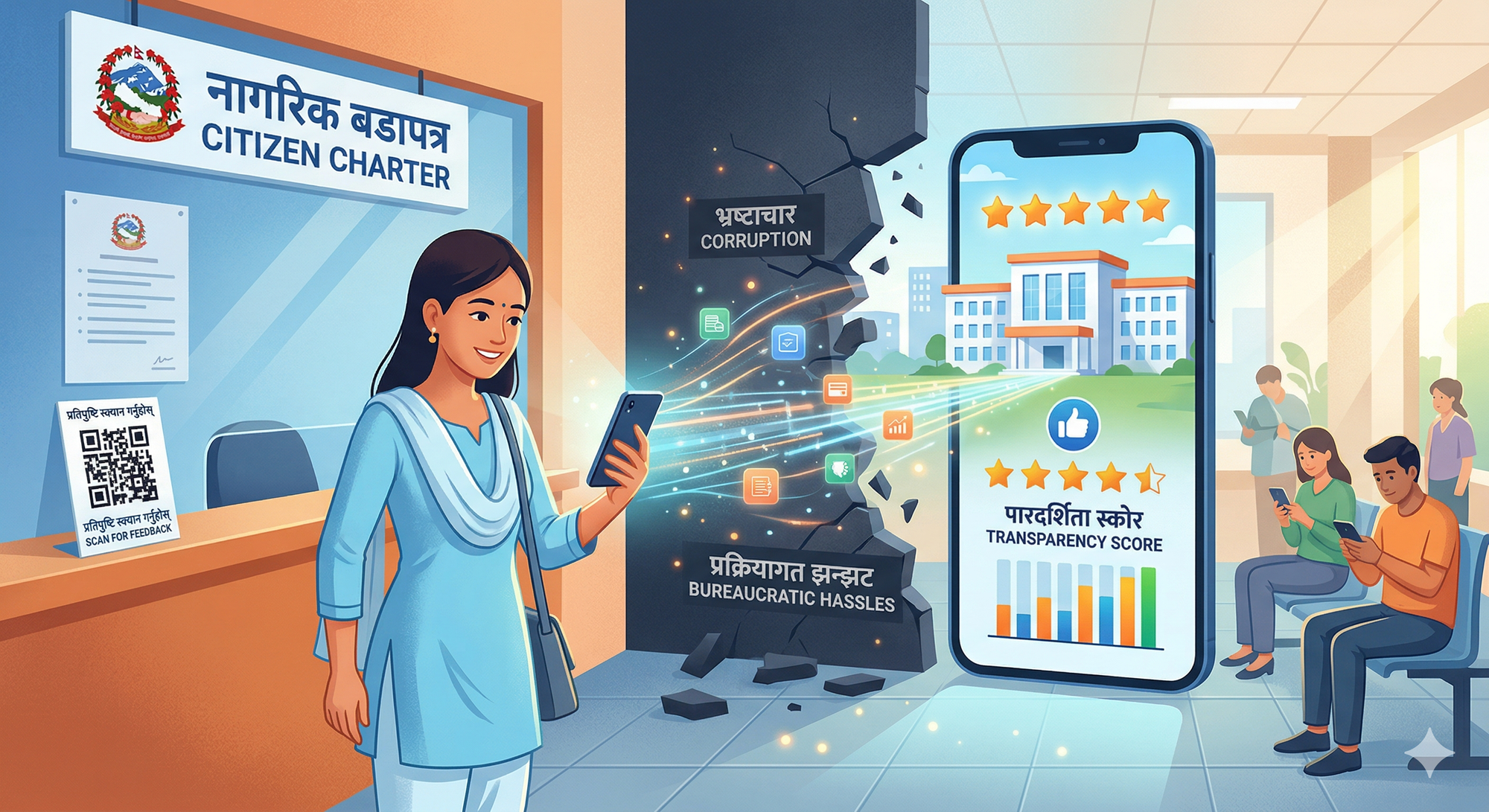
Breaking the Gatekeeper: A Blueprint for Citizen-Powered Governance in Nepal
A comprehensive blueprint for shifting oversight power from institutions to citizens through digital accountability mechanisms.
Executive Summary
Corruption in Nepal's public sector persists not merely through individual malfeasance but through structural information asymmetry—systems designed to isolate citizens, fragment experiences, and protect opacity. This proposal outlines a mobile-based accountability platform that transforms service seekers into real-time monitors, creating data-driven transparency where silence once prevailed.
| Dimension | Traditional System | Mobile Accountability Platform |
|---|---|---|
| Feedback Mechanism | Physical complaints, formal letters, lawsuits | Instant mobile ratings tied to specific desks/offices |
| Data Aggregation | Isolated incidents, no pattern recognition | Real-time heat maps, AI-driven anomaly detection |
| Response Time | Months to years for investigation | Automated alerts trigger immediate review |
| Citizen Protection | Complainant identity exposed, retaliation risk | Verified but anonymized feedback, institutional targeting |
| Performance Visibility | Internal, subjective evaluations | Public trust scores, competitive benchmarking |
| Engagement Model | Complaint as burden | Feedback as contribution with recognition/incentives |
The Architecture of Impunity: Three Structural Failures
1. The Gatekeeper Effect: Information as Currency
In Nepal's Malpot (Land Revenue) and Yatayat (Transport) offices, civil servants possess exclusive knowledge of internal procedures—knowledge they can weaponize into artificial hurdles. The citizen facing a "lost file" or "additional requirement" has no independent verification mechanism. The choice becomes: indefinite delay or facilitation fee.
- Plausible Deniability: Bribes are never explicitly demanded—only "the way things work" is explained
- Asymmetric Verification: Citizens cannot confirm what documents are truly required
- Manufactured Complexity: Simple processes are deliberately obscured to create rent-seeking opportunities
2. The Anonymity of Inefficiency: Performance Without Consequence
Civil service evaluation in Nepal follows seniority timelines, not achievement metrics. A desk officer may process licenses slowly, demand unauthorized fees, or humiliate applicants without career repercussion because:
| What Should Matter | What Actually Matters | Result |
|---|---|---|
| Citizen satisfaction | Years of service | No incentive for courtesy or efficiency |
| Transparency in fee collection | Revenue targets | Unofficial fees supplement official shortfalls |
| Service delivery speed | File movement without complaint | Delay becomes negotiation tactic |
| Public reputation | Superior's personal assessment | Isolated incidents never aggregate into pattern |
3. High Friction Reporting: The Deterrence Architecture
Traditional complaint channels share a designed or emergent feature: reporting costs exceed expected benefits. Consider the traditional complaint journey:
- Identification: Locating correct authority across overlapping jurisdictions
- Composition: Drafting formal complaints requiring literacy and legal awareness
- Evidence: Documenting cash transactions and unrecorded conversations
- Submission: Physical travel to distant offices, time away from livelihood
- Waiting: Months or years of procedural delay
- Retaliation Risk: Exposure to officials named in complaint
The rational citizen chooses strategic silence. This selection effect means only the most desperate or protected complain, while thousands of daily micro-abuses vanish unrecorded.
The Digital Ombudsman: Three Transformational Pillars
Pillar 1: Direct Desktop Accountability
Every service desk receives a unique QR code identifier. Citizens "check in" via mobile app upon arrival, tethering abstract bureaucracy to specific moments, places, and individuals.
| Feature | Implementation | Behavioral Impact |
|---|---|---|
| QR Code Display | Printed code at each service window, linked to official ID database | Official knows interaction is traceable; visibility modifies behavior |
| Geofencing Verification | App detects office entry via GPS boundaries | Prevents remote false reporting |
| Timestamp Logging | Automatic recording of arrival and service completion | Creates efficiency benchmarks; identifies delay patterns |
| Service Type Selection | User specifies purpose (e.g., "land mutation," "license renewal") | Enables granular analysis by transaction complexity |
Pillar 2: Public Performance Metrics
Raw feedback transforms into multi-layered intelligence through algorithmic analysis:
- Individual Trust Score
- Cumulative ratings per civil servant for internal management—identifying high performers for reward, low performers for intervention. Privacy-protected; not publicly shaming individuals but enabling targeted support or reassignment.
- Institutional Trust Score
- Aggregated office-level ratings published on transparency dashboard. Malpot Birgunj: 4.2/5. Malpot Janakpur: 2.8/5. Creates competitive pressure and reputational accountability.
- Systemic Pattern Analysis
- Cross-office comparison reveals structural problems. All Yatayat offices scoring low on efficiency suggests understaffing; specific regional transparency clusters suggest localized corruption networks.
Pillar 3: Gamified Civic Engagement
Feedback transforms from burden to contribution through recognition and incentive systems:
- Civic Points Accumulation: Base points per submission, bonuses for consistency and detailed commentary
- Status Titles: "Active Citizen" → "Transparency Guardian" → "Public Advocate" (social media shareable)
- Micro-Incentives: Retail discounts, bank service priority, fee waivers for future government services
- Impact Visualization: "Your feedback helped identify a pattern leading to CIAA investigation"
- Community Competition: Municipality rankings for "Most Active Citizenry"
The Citizen-to-System Workflow: Five Stages
Stage 1: Verification and Entry
| User Category | Primary Method | Alternative Method |
|---|---|---|
| Smartphone owners with NID | NID number + biometric verification (fingerprint/face) | Verified mobile number linked to NID database |
| Smartphone owners without NID | Verified mobile number + temporary profile | Assisted verification at office kiosk |
| Non-smartphone users | SMS-based feedback (short code) | Office tablet with neutral attendant assistance |
Stage 2: The Feedback Interaction
Three high-impact questions capturing corruption-correlated dimensions:
| Question | What It Measures | Corruption Signal |
|---|---|---|
| Transparency: "Were fees charged exactly as listed on the citizen charter?" | Adherence to official fee schedules | Unofficial "extra fees" or "facilitation charges" |
| Behavior: "Was the official professional and helpful?" | Service dignity and respect | Arrogance of power, deliberate humiliation tactics |
| Efficiency: "Was service provided within promised timeframe?" | Timeliness of delivery | Artificial delays to justify expedited processing fees |
Scoring: 1-5 scale per question, plus optional qualitative comment field. Completion time: under 60 seconds.
Stage 3: Data Processing and The Heat Map
Machine learning algorithms identify patterns across multiple dimensions:
- Temporal Analysis: Sudden rating drops indicate staff changes or system failures; gradual declines suggest management deterioration; seasonal patterns distinguish capacity constraints from corruption
- Comparative Benchmarking: Performance relative to peer offices controls for service complexity
- Correlation Detection: Relationships between transparency complaints and specific fee types, or behavior scores and time of day
- Anomaly Detection: Deviant reports trigger human review to identify genuine scandals or malicious false reporting
Stage 4: The Trigger Mechanism
| Zone | Threshold | Automated Response | Timeline |
|---|---|---|---|
| Green | ≥4.0/5 for 6+ consecutive months | Public commendation; ministerial certificates; media coverage; performance bonus eligibility; resource allocation preference | Monthly review |
| Yellow | 2.5-4.0/5 or declining trend | Preventive support; technical assistance; training programs; resource supplements; management consultation | Immediate alert + 30-day intervention plan |
| Red | <2.5/5 or transparency complaint spike | Automatic alert to CIAA, relevant Ministry, local oversight committees; data package for targeted investigation; internal audit mandate | Immediate alert + 7-day preliminary response required |
Stage 5: The Transparency Dashboard
Public-facing interface with tiered access:
- Citizen View
- Office comparison by district; optimal service time identification (hourly rating patterns); preparation guidance (low transparency offices → bring exact change, demand receipts)
- Media View
- Outlier highlighting for investigative leads; ranking stories; reform impact tracking
- Researcher View
- Open datasets for academic analysis; corruption pattern studies; policy evaluation metrics
- Government View
- Portfolio performance summaries; resource allocation optimization; political accountability preparation
Implementation Roadmap: From Pilot to National Infrastructure
Phase 1: Proof of Concept (Year 1)
| Parameter | Specification |
|---|---|
| Service Types | Malpot land services, Yatayat vehicle registration, Municipal construction permits |
| Geographic Scope | Kathmandu (urban complexity), Kailali (rural challenges) |
| User Target | 10,000+ verified users |
| Engagement Target | 30% feedback completion rate among app users |
| Impact Target | Identification of 3+ significant performance patterns requiring intervention |
Phase 2: Expansion and Integration (Years 2-3)
- National district coverage for pilot services
- National ID database integration
- CIAA complaint system linkage
- Ministry performance monitoring incorporation
- Non-smartphone assisted entry deployment
- Gamification feature activation
Phase 3: Institutionalization (Years 4-5)
- Expansion to all major public services (health, education, police)
- Permanent government infrastructure with dedicated budget
- Predictive analytics and corruption risk modeling
- International open-data standards compliance
- Civil service evaluation system integration
Critical Success Factors
| Risk Factor | Mitigation Strategy |
|---|---|
| Political interference | High-level champion commitment (PM/CM level); public integrity pledges; opposition party buy-in |
| Bureaucratic resistance | Union engagement framing system as professionalization tool; reward emphasis over punishment focus; pilot success demonstration |
| Data manipulation | Blockchain-based feedback verification; independent security audits; algorithmic anomaly detection; whistleblower protection |
| Digital divide exclusion | SMS alternatives; office kiosk assistance; community volunteer networks; progressive smartphone adoption support |
| Platform fatigue | Gamification refresh; impact feedback loops; community challenges; tangible incentive maintenance |
Comparative Analysis: Global Precedents and Nepal's Innovation
| Platform | Country | Key Feature | Nepal Adaptation |
|---|---|---|---|
| FixMyStreet | United Kingdom | Geolocated public infrastructure reporting | Desk-level precision rather than general location; integration with internal performance systems |
| IPaidABribe | India | Crowdsourced bribery reporting | Proactive transparency prevention vs. reactive corruption documentation; official system integration vs. NGO parallel |
| Citizen's Charter | Philippines | Service standards publication and monitoring | Real-time digital verification of charter compliance; automated consequence triggers |
| Observatorio Ciudadano | Mexico | Citizen monitoring of public services | Gamification for engagement sustainability; AI pattern recognition for scale |
| ProZorro | Ukraine | Open contracting and procurement transparency | Extension to service delivery (post-procurement); individual citizen interface vs. business-focused |
Nepal's Distinctive Innovation: While global platforms focus on either infrastructure reporting (FixMyStreet), corruption documentation (IPaidABribe), or procurement transparency (ProZorro), the proposed system integrates real-time service monitoring with automated institutional response and gamified civic engagement—creating a closed accountability loop rather than an open reporting channel.
Projected Impact: Quantifying Transformation
| Indicator | Baseline (2025) | Year 3 Target | Year 5 Target |
|---|---|---|---|
| Platform Users | 0 | 500,000 | 2,000,000 (7% of population) |
| Monthly Feedback Submissions | 0 | 50,000 | 200,000 |
| Offices with Public Trust Scores | 0 | 2,000 (major offices) | 5,000 (comprehensive) |
| Green Zone Offices (% of rated) | N/A | 30% | 45% |
| Red Zone Investigations Triggered | 0 | 150/year | 100/year (decreasing as prevention works) |
| Corruption Perception Index | 33/100 | 38/100 | 45/100 |
| Citizen Satisfaction (% satisfied) | 35% | 50% | 65% |
Economic Impact Calculation
Direct savings from reduced unofficial fees (estimated annual "leakage" in land and transport services: NPR 5-8 billion). Indirect gains from:
- Reduced time cost of service seeking (average 2.3 days per transaction → target 0.5 days)
- Increased foreign investment confidence (transparency metrics as due diligence tool)
- Improved tax compliance (trust in government services increases voluntary compliance)
Conclusion: From Patronage to Partnership
The mobile accountability platform represents more than anti-corruption technology—it is an instrument of democratic deepening. Nepal's political transformations established electoral rights; this system extends accountability to the administrative state where citizens daily encounter government power.
By transforming isolated victims into connected monitors, the platform addresses the silence that has always protected corruption. The middleman's power—whether the desk officer demanding unofficial fees or the political broker allocating jobs—depends on information isolation. When every citizen carries oversight capacity, when every interaction generates persistent data, when patterns become publicly visible, the economics of corruption fundamentally change.
The shadows where corruption thrives require darkness. This system turns on the lights.
Immediate Next Steps
- Stakeholder Consultation: Ministry of Federal Affairs and General Administration, CIAA, civil service unions, tech sector representatives
- Technical Feasibility Study: National ID integration assessment, mobile penetration analysis, cybersecurity architecture design
- Pilot Funding: International development partner engagement (World Bank, UNDP, bilateral donors)
- Legal Framework Drafting: Data protection provisions, whistleblower protections, automated alert statutory recognition
- Champion Identification: Political leadership commitment at highest level