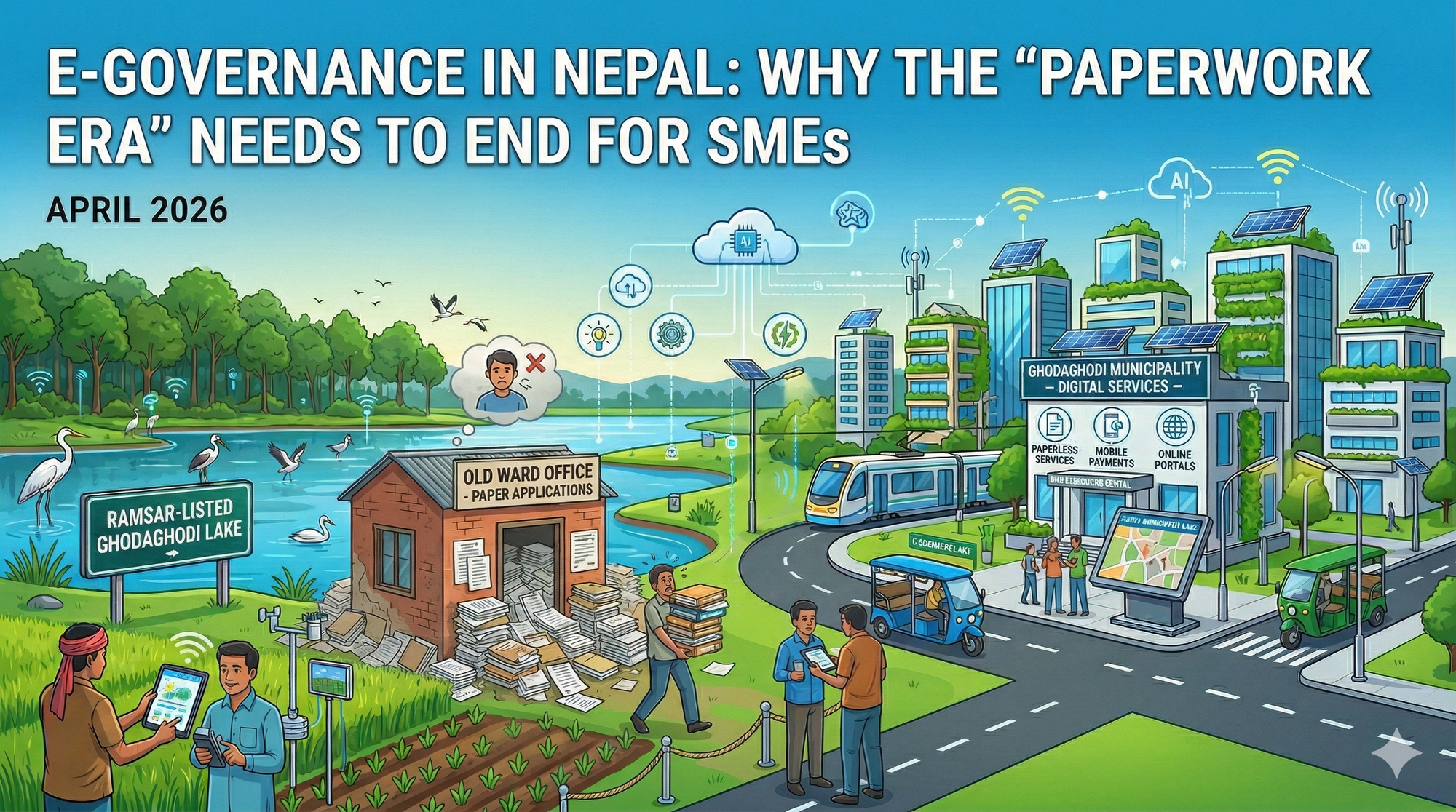
E-Governance in Nepal: Why the "Paperwork Era" Needs to End for SMEs
How digital transformation can unlock Nepal's entrepreneurial potential and accelerate economic growth.
In Nepal, starting and running a small or medium enterprise (SME) often feels like a test of patience rather than business acumen. The entrepreneur with a innovative idea, the shopkeeper with expansion plans, the manufacturer with export potential—all face a common enemy: paperwork.
As of 2026, Nepali SMEs still navigate a labyrinth of physical forms, in-person visits, and opaque procedures that consume time, drain resources, and often extinguish ambition before it can flourish. This is not merely an inconvenience; it is a structural constraint on national development.
The solution is comprehensive E-Governance—not digitization of existing processes, but reimagining how government and business interact. For Nepal's SMEs, this transformation is not optional; it is existential.
The Current Burden: How Paperwork Strangles Enterprise
To understand the scale of the problem, follow the journey of a typical Nepali entrepreneur attempting to establish a small manufacturing unit:
| Process | Physical Steps Required | Time (Days) | Unofficial Costs |
|---|---|---|---|
| Company Registration | Inland Revenue Department visit, document notarization, physical form submission, follow-up visit | 7-14 | "Fast-track" facilitation |
| PAN/VAT Registration | Tax office visit, physical verification, manual ledger setup | 5-10 | Consultant fees, "processing" |
| Municipal License | Ward office visit, recommendation letter, municipal office submission, inspection scheduling | 10-21 | Multiple "facilitation" points |
| Import/Export License | Department of Commerce visit, bank guarantee physical submission, customs registration | 14-30 | Broker fees, "clearance" |
| Annual Renewal | Repeat physical visits for each agency, updated document submission | 5-10 per agency | Repeat facilitation |
| TOTAL | 40+ physical touchpoints | 41-85 days | 10-20% of startup capital |
This is the compliance calendar for a legitimate business. For each day spent navigating paperwork, the entrepreneur is not developing product, not finding customers, not creating jobs. The cost is not merely the bribe paid; it is the opportunity foregone.
The hidden tax: Studies estimate that Nepali SMEs spend 30-40% of management time on regulatory compliance rather than business development. This is the true cost of the paperwork era.
The E-Governance Solution: From Paper to Platform
E-Governance for SMEs is not about putting PDF forms online. It is about end-to-end digital transformation of the business-government interface:
| Layer | Function | SME Benefit | Technology |
|---|---|---|---|
| Identity Layer | Single business ID linked to owner NID | One-time verification; no repeated document submission | National ID integration; biometric authentication |
| Portal Layer | Unified business portal for all government services | One dashboard for registration, tax, licenses, compliance | Cloud-based platform; mobile-responsive design |
| Payment Layer | Integrated fee payment and refund | Instant, traceable, corruption-resistant transactions | Digital Rupee integration; mobile wallets |
| Processing Layer | Automated workflow; AI-assisted approval | 24/7 service; predictable timelines; no queue | Workflow automation; machine learning verification |
| Feedback Layer | Real-time service rating; complaint escalation | Voice in service improvement; accountability mechanism | Citizen feedback platform; blockchain audit trail |
The Transformed Journey: Same Entrepreneur, Digital Era
With E-Governance, the same manufacturing entrepreneur experiences:
- Day 1: Online company registration via portal—2 hours, zero physical visit, instant certificate download
- Day 2: PAN/VAT registration auto-triggered, AI-verified, approved overnight
- Day 3: Municipal license applied—digital inspection scheduled, drone/photo verification where appropriate
- Day 5: All registrations complete; business operational; total cost: official fees only
- Ongoing: Annual renewals auto-reminded, one-click completion, compliance dashboard visible year-round
Time saved: 36-80 days. Cost saved: 10-20% of capital. Management attention: returned to business building.
Economic Impact: Why SMEs Matter for Nepal
SMEs are not a marginal sector; they are the backbone of Nepal's economy:
| Indicator | SME Contribution | Potential with E-Governance |
|---|---|---|
| GDP Share | 22% | 30%+ (reduced compliance drag) |
| Employment | 1.7 million jobs | 2.5 million (new business formation) |
| Export Contribution | 15% of total exports | 25% (simplified trade procedures) |
| Tax Compliance | 35% of eligible SMEs registered | 70%+ (reduced barrier to formalization) |
| Female Entrepreneurship | 23% of SMEs women-led | 40%+ (reduced mobility/safety barriers) |
When we simplify SME governance, we do not merely reduce paperwork; we expand the entrepreneurial base. Women who cannot travel repeatedly to government offices gain entry. Rural entrepreneurs connect to national markets. Youth with ideas but no connections find a path forward.
Implementation Priorities: The 2026-2028 Roadmap
E-Governance for SMEs requires coordinated action across multiple agencies. Here is the practical pathway:
- Phase 1: Foundation (2026)
- Launch unified business portal integrating IRD, Company Registrar, and municipal services
- Implement Digital Rupee payment gateway for all government fees
- Pilot in Kathmandu Valley and one provincial hub (e.g., Pokhara or Dhangadhi)
- Phase 2: Integration (2027)
- Add customs, labor department, and social security integration
- Launch mobile-first interface for smartphone-dominant users
- Deploy feedback mechanisms for service quality monitoring
- Expand to all provincial capitals
- Phase 3: Intelligence (2028)
- AI-assisted approval for low-risk applications
- Predictive compliance—proactive reminders, automated renewals
- Data-driven policy—SME dashboards showing sectoral health, regional gaps
- National coverage including rural municipalities
Critical Success Factors
| Factor | Requirement | Risk if Neglected |
|---|---|---|
| Political Will | Ministerial commitment to transparency; anti-corruption enforcement | Digital front-end with corrupt back-end; facade e-governance |
| Technical Talent | Domestic dev teams; diaspora tech return; competitive salaries | Vendor lock-in; unsustainable foreign contracts; system decay |
| Connectivity | Rural broadband; offline-capable apps; service centers | Urban bias; exclusion of rural SMEs; digital divide widening |
| Legal Framework | Digital signature recognition; electronic evidence law; data protection | Legal ambiguity; court challenges; business uncertainty |
| Change Management | Staff retraining; incentive realignment; user education | Sabotage by displaced intermediaries; low adoption; reversion to paper |
Conclusion: The End of the Paperwork Era
Nepal stands at a threshold. The "Paperwork Era"—with its queues, its gatekeepers, its invisible costs—is a legacy of the 20th century. In the 21st century, entrepreneurship cannot wait 85 days to begin.
E-Governance for SMEs is not a technical luxury; it is an economic imperative. Every day we delay, businesses die in conception, jobs go uncreated, and potential exports never ship. Every day we accelerate, we unlock the creative energy of a young, ambitious population.
The tools exist. The Digital Rupee provides the payment layer. The feedback platforms provide the accountability mechanism. The diaspora provides the technical talent. What remains is the will to integrate, to launch, and to iterate.
"The best time to digitize SME governance was five years ago. The second best time is now."
Are you an SME owner navigating Nepal's paperwork maze? What would digital transformation mean for your business? Share your story below.