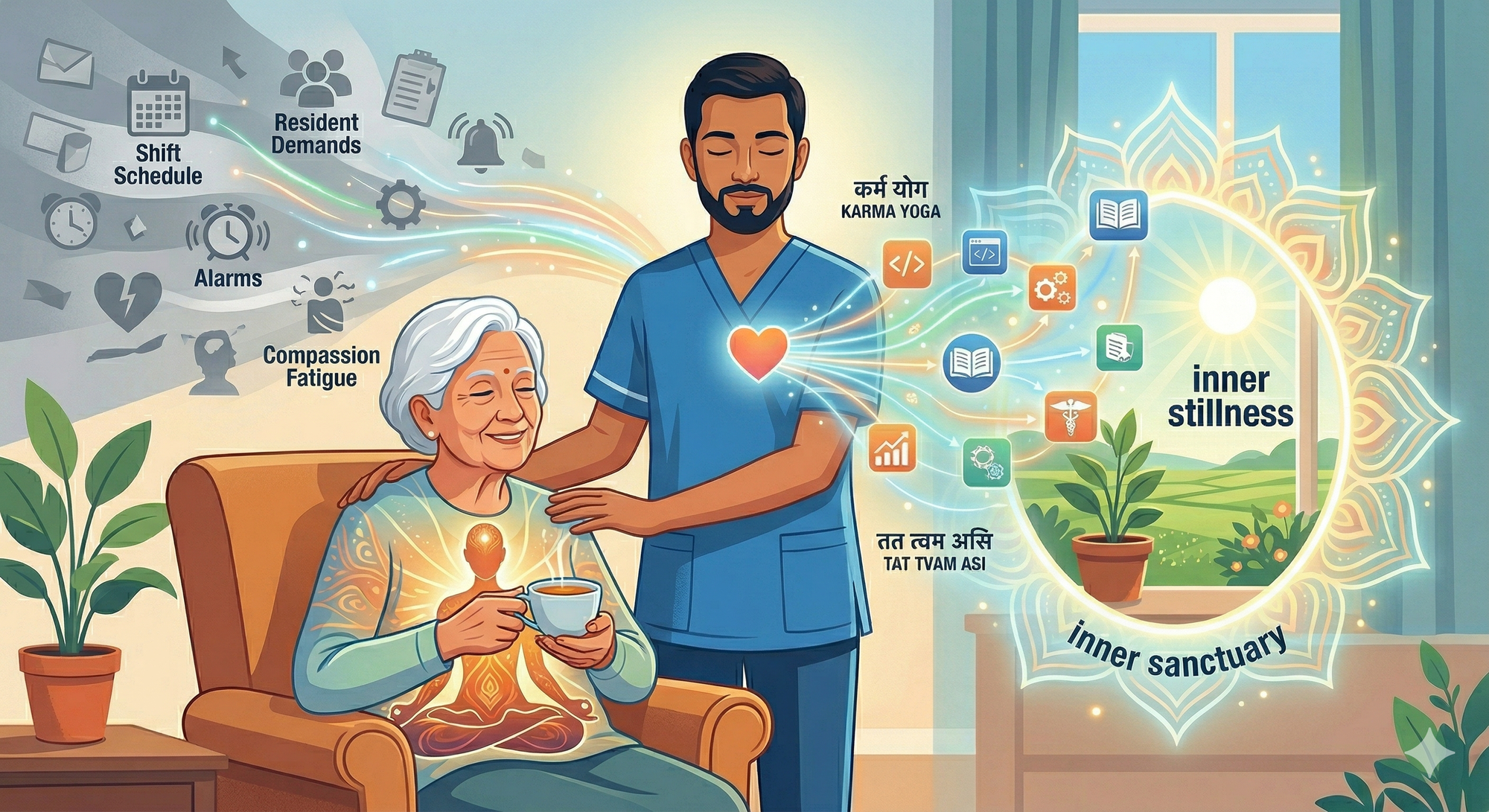
Finding Stillness in a Busy Career: Applying Vedic principles to the life of a Personal Care Worker.
Transforming the grind of caregiving into spiritual practice through ancient wisdom.
Working as a Personal Care Worker (PCW), especially in a high-paced environment like Bupa in Traralgon, is more than just a job—it is a rigorous practice of patience, physical labor, and emotional labor. In the middle of back-to-back shifts and the responsibility of caring for others, finding stillness can feel impossible.
However, by applying Vedic principles, we can transform the "grind" of caregiving into a source of spiritual strength and mental clarity. The hallway of a care home becomes a temple; the routine task becomes an offering; the difficult moment becomes a teacher.
1. Karma Yoga: Excellence Without Attachment
The core of the Bhagavad Gita teaches Karma Yoga: the path of selfless action performed without attachment to results. As a PCW, you are constantly performing actions for the benefit of others—bathing, feeding, comforting, healing. This is the very definition of Karma Yoga in practice.
"Karmanye vadhikaraste ma phaleshu kadachana"
You have a right to your labor, but not to the fruits of your labor.
The Application in Care Work
In a care home, things often don't go as planned. A resident might be difficult, a shift might be understaffed, or your best efforts might seem unappreciated. Karma Yoga teaches us to focus entirely on the quality of care in the present moment, rather than stressing over the outcome or seeking constant validation.
| Attached Mindset | Karma Yoga Mindset | Practical Result |
|---|---|---|
| "I hope they appreciate my effort" | "I offer this care as my duty" | Freedom from external validation |
| "This shift is too hard, I can't wait for it to end" | "This moment of care is complete in itself" | Presence replaces clock-watching |
| "If only the system were better, I could do my job" | "I bring excellence to what is within my control" | Empowerment amid constraints |
| Stress over outcomes and recognition | Focus on the integrity of the action itself | Sustained energy, reduced burnout |
When you work for the sake of the work itself, the "busy-ness" loses its power to drain you. The shift becomes a field of practice, not a battlefield of expectations.
2. Atman in Every Resident: Seeing the Sacred
It is easy to see residents only through the lens of their medical needs, their diagnosis, or their age. The care plan becomes the person; the condition becomes the identity. Vedic philosophy, particularly Advaita Vedanta, teaches that the same underlying consciousness (Atman) resides in everyone.
"Tat Tvam Asi"
That Thou Art — The same Self dwells in all beings.
The Application in Personal Care
When providing personal care—assisting with bathing, dressing, or eating—remind yourself that the spark of life in the person you are assisting is the same spark within you. This shift in perspective turns a routine task into a sacred interaction.
Consider the difference:
- Transactional view: "I am washing a body. This is my task. I need to finish quickly to move to the next resident."
- Advaita view: "I am serving the Self in this form. The consciousness witnessing through their eyes is the same consciousness within me. This touch is an acknowledgment of unity."
This recognition builds a natural bridge of empathy that reduces the "compassion fatigue" often felt in healthcare. When we see ourselves in the other, care becomes connection rather than consumption of energy.
For a deeper exploration of how non-duality transforms our relationship with technology and service, see my reflection on Advaita Vedanta in the Age of AI.
3. Pratyahara: Creating an Inner Sanctuary
In the Vedic tradition, Pratyahara is the practice of "withdrawing the senses"—the fifth limb of Patanjali's Ashtanga Yoga. It is not escapism, but the conscious management of sensory input to prevent overwhelm and maintain inner clarity.
For a PCW, the workplace is inherently loud—alarms, conversations, call bells, physical movement, emotional intensity. Without Pratyahara, the senses become flooded, leading to the exhaustion that characterizes burnout.
Micro-Rituals for the Care Environment
Pratyahara need not require a meditation cushion or extended silence. Use small "micro-rituals" woven into the fabric of your shift:
| Moment | Practice | Duration | Effect |
|---|---|---|---|
| Between residents | Three conscious breaths, eyes closed or soft-focused | 30 seconds | Nervous system reset |
| During hand washing | Feel water temperature fully; let sound of water be the only sound | 20 seconds | Sensory narrowing, present-moment anchor |
| Before entering a room | Visualize a "shield" of stillness; set intention for the interaction | 10 seconds | Boundary setting, purposeful presence |
| Meal break (even briefly) | Eat without phone; taste each bite; withdraw from work stimuli | 5-10 minutes | Deep restoration, digestive health |
| End of shift | "Release" visualization: care given is complete; no further obligation | 2 minutes | Prevention of rumination, clean transition home |
By briefly withdrawing into your inner stillness, you recharge your "battery" for the next task. Pratyahara is not avoidance—it is the disciplined preservation of the inner resource that makes compassionate care possible.
From Self to System: The Larger Journey
Applying these principles is part of a larger journey toward a balanced life—one that honors both inner transformation and outer action. The stillness we cultivate in the care home need not end when we clock out.
Collective Action for Better Systems
Just as we find stillness internally, we can work toward better systems externally. See my thoughts on the People's Roadmap initiative to see how collective feedback and digital accountability can improve the environments we work in—from care homes to communities.
The Digital Balance
In a world where we go from caregiving to scrolling, understanding Advaita Vedanta in the Age of AI can help us maintain that hard-won stillness even when we are back on our phones—recognizing digital phenomena as Maya (appearance) while remaining rooted in the witnessing consciousness.
Purpose Beyond Borders
For those serving abroad who feel called to contribute their developed skills back home, my reflection on Brain Drain to Brain Gain explores how caregiving expertise, when grounded in deeper purpose, becomes part of national transformation.
Final Thought: The Sanctity of Service
Being a Personal Care Worker is one of the most practical forms of spiritual practice. You are literally the hands and feet of service. In a world that often values abstraction over action, the PCW embodies the truth that enlightenment is not escape from the world but full engagement with it—without attachment, with clear seeing, and with preserved inner resources.
By bringing Vedic mindfulness into the hallways of the care home, you don't just survive your shift—you sanctify it. Each act of care becomes an offering; each moment of presence becomes a prayer; each difficult interaction becomes an opportunity to see the Self in the other.
"The highest form of worship is to serve all beings as manifestations of the Divine."
— Vedic Teaching
How do you find a moment of peace during a busy shift? Let's discuss in the comments.