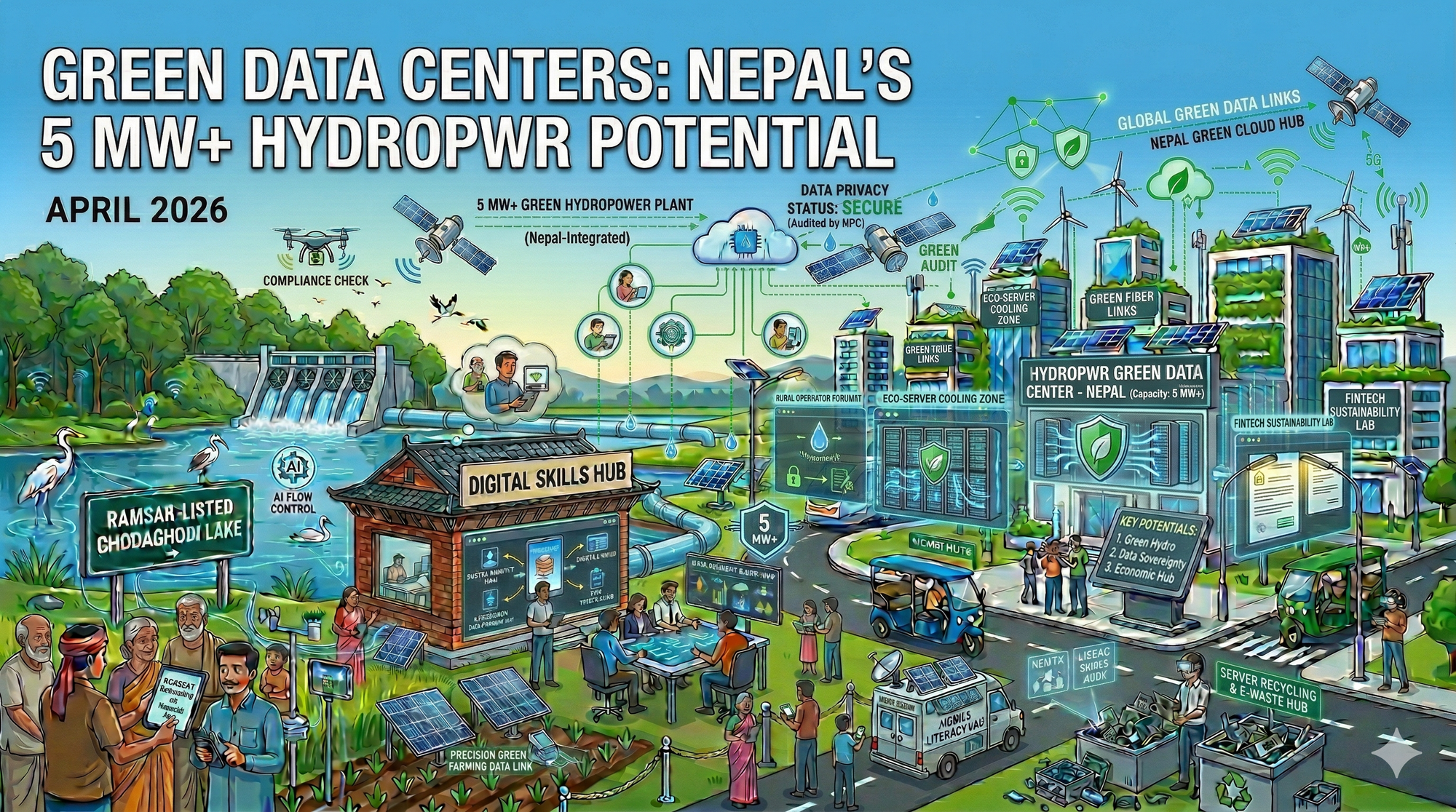
Green Data Centers: The potential for Nepal to host 5 MW+ eco-friendly data facilities using hydropower.
Beyond Hydropower Exports: Positioning the Himalayas as the World’s Sustainable Digital Vault.
As we navigate through 2026, the global digital landscape is undergoing a radical transformation. The explosion of Generative AI, Large Language Models (LLMs), and high-frequency trading has created an insatiable hunger for raw computing power. However, this progress comes with a heavy environmental price tag. Traditional data centers are notorious energy gluttons, often straining local power grids and relying on fossil fuels for both electricity and massive cooling systems.
This global challenge presents a unique, multi-billion dollar opportunity for Nepal. With its abundant hydropower potential and naturally cool Himalayan climate, Nepal is no longer just a destination for trekking; it is the most competitive location in South Asia for Green Data Centers. By hosting 5 MW+ eco-friendly facilities, we can pivot from exporting raw electrons to exporting high-value digital services.
The Strategic Edge: Why the Himalayas?
Hyperscale data center operators (like Google, Amazon, and Microsoft) prioritize three primary factors: Reliable Energy, Cooling Efficiency, and Latency. Nepal possesses a structural advantage in the first two that few places on earth can replicate.
| Feature | Traditional Hubs (Singapore/India) | The Nepal Advantage |
|---|---|---|
| Energy Mix | Heavy reliance on Natural Gas/Coal | 100% Renewable Hydropower |
| Ambient Temperature | Tropical/High Humidity (High Cooling Demand) | Naturally Cool (Low-Cost Free Cooling) |
| Power Usage Effectiveness (PUE) | 1.5 - 1.8 (Average) | Target 1.1 - 1.2 (World Class) |
| Energy Cost | Increasing due to carbon taxes | Fixed, low-cost hydropower |
Natural Cooling: The Silent Revenue Driver
In a standard data center, nearly 40% of electricity consumption goes toward keeping the servers cool. In high-altitude regions of Nepal, such as the Kathmandu Valley or even higher provincial hubs, we can utilize "Free Cooling"—simply using the outside air to regulate temperatures. This reduces operational costs (OPEX) by 30-50% compared to Mumbai or Singapore, making Nepali hosting prices globally competitive.
The "Data as Export" Paradigm Shift
For years, Nepal’s economic plan has focused on selling surplus electricity to India and Bangladesh. While this brings in revenue, it is essentially exporting a "raw material." By using that same electricity to power domestic data centers, we engage in Value-Added Exports.
- Higher Revenue: 1 unit of electricity sold to India earns roughly 8-10 NPR. That same unit used to power an international data center can generate 5 to 10 times that value in service fees, IT support jobs, and digital infrastructure taxes.
- Job Creation: A 5 MW data center requires an ecosystem of network engineers, cybersecurity experts, cooling technicians, and administrative staff. It fuels the local IT outsourcing industry.
- Technological Spillover: Establishing world-class facilities attracts global tech giants, encouraging knowledge transfer and boosting the technical confidence of our local workforce.
Building the Digital Fortress: Trust and Connectivity
To convince a global bank or an AI startup to store their data in Nepal, we need more than just cheap power. We need institutional trust and physical reliability.
1. Legal Sovereignty: Data Protection 2082
International investors need to know that data stored in Nepal is legally protected from arbitrary seizure or snooping. Our move toward the Personal Data Protection Policy 2082 is a major step forward. By aligning with international frameworks like the GDPR, Nepal can market itself as a "Digital Neutral Zone" or a "Sovereign Data Haven."
2. Redundant Fiber Infrastructure
Latency is the enemy of digital services. Nepal currently relies heavily on fiber gateways through India. To become a hub, we must aggressively pursue trans-Himalayan fiber-optic links through China. Having a "Dual-Exit" strategy through both neighbors ensures that even if one line fails, the world's data stays online.
3. Grid Stability via AI
Data centers cannot tolerate a single second of downtime. This requires an AI-powered smart grid that can intelligently manage hydropower surges and dry-season fluctuations, ensuring 99.999% uptime for digital tenants.
Fueling the Smart Cities of Sudurpaschim
Green Data Centers are not just for foreigners; they are the bedrock of our own development. Localized data facilities will power our Smart City Vision in Ghodaghodi and other municipalities. By hosting our own e-governance portals and IoT data locally, we reduce latency for our citizens and ensure that our critical data remains within our borders.
Conclusion: Turning Himalayan Surplus into Digital Strength
The roadmap for Nepal’s prosperity is being rewritten. We are moving from a nation that only exports its youth and its water to a nation that hosts the digital future. Green Data Centers represent a marriage of our ancient geography and tomorrow's technology.
"For a thousand years, our glaciers provided water to the plains. For the next thousand, our rivers will provide the power to compute the collective knowledge of humanity."
Should Nepal focus on building data centers or continue prioritizing cross-border electricity sales? The choice will define our economy for the next fifty years.