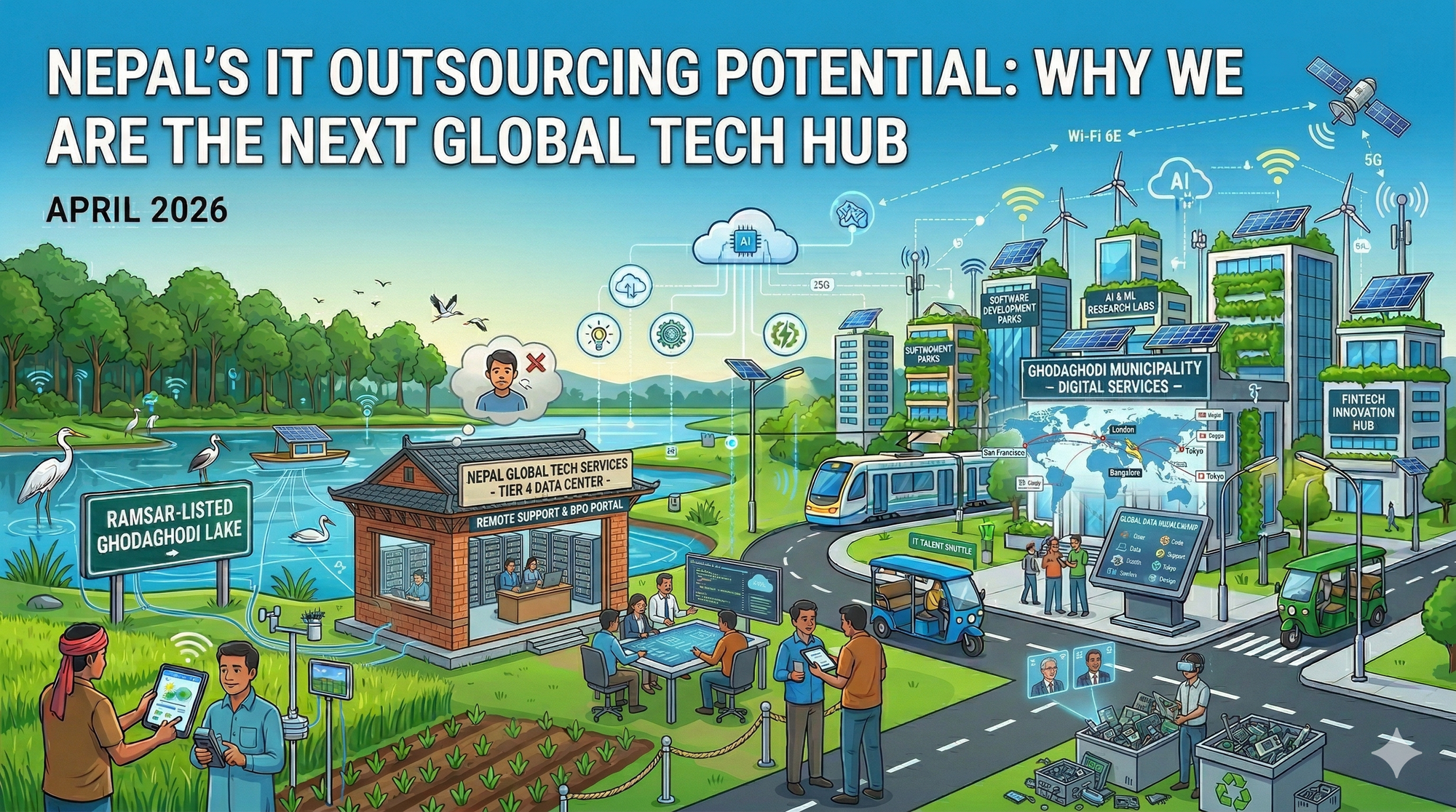
Nepal’s IT Outsourcing Potential: Why we are the next global tech hub.
From $1 billion to $10 billion: How Nepal can capture the global demand for digital talent.
In 2024, Nepal's IT sector crossed a historic threshold: $1 billion in export revenue. For a country long dependent on remittances and tourism, this milestone signals something profound—a shift from labor export to knowledge export, from serving tourists to serving global enterprises.
But $1 billion is merely the beginning. The global IT outsourcing market exceeds $500 billion annually, growing at 8-10% per year as every industry becomes a technology industry. Nepal, with its unique combination of young talent, competitive costs, and strategic timezone, is positioned to capture a significant share of this expansion.
The question is not whether Nepal can become a global tech hub. The question is whether we will move fast enough to seize the moment before competitors close the window. This post outlines why Nepal is ready, what we must build, and how we get from $1 billion to $10 billion.
Nepal's Competitive Advantages: The Case for Global Buyers
Why should a company in Silicon Valley, London, or Singapore choose Nepal over India, Vietnam, or Eastern Europe? The answer lies in a distinctive combination of factors:
| Factor | Nepal | India (Tier-1) | Vietnam | Philippines |
|---|---|---|---|---|
| Average Developer Cost | $15-25/hour | $40-80/hour | $20-35/hour | $25-40/hour |
| English Proficiency | High (legal/education system) | High | Moderate | Very High |
| Timezone Alignment | GMT+5:45 (overlaps EU morning, US evening) | GMT+5:30 (similar) | GMT+7 (limited US overlap) | GMT+8 (limited US overlap) |
| Talent Pool Growth | 30% annual increase in CS graduates | Mature (slower growth) | 20% annual growth | 15% annual growth |
| Cultural Compatibility | Service-oriented; Western education exposure | High | Moderate | High (US colonial history) |
| Government Support | Emerging (priority sector status) | Established but bureaucratic | Strong | Strong |
Nepal's sweet spot is clear: high-quality talent at emerging-market costs, with English fluency and cultural adaptability that rival established players. For cost-conscious buyers seeking alternatives to India's inflation, Nepal offers compelling value.
The Talent Pipeline: Education Meets Industry
Nepal produces approximately 15,000 computer science and IT graduates annually from universities and technical institutes. This number has grown 300% over the past decade, driven by:
- Expansion of IT programs at Tribhuvan University, Kathmandu University, and Pokhara University
- Proliferation of private technical colleges in Kathmandu, Pokhara, and emerging hubs
- Growing prestige of tech careers relative to traditional medicine/engineering
- Return of diaspora tech professionals who mentor and teach
The Skills Mix: What Nepal Offers
| Domain | Maturity Level | Sample Capabilities | Global Demand Trend |
|---|---|---|---|
| Web Development | Mature (High volume) | React, Node.js, full-stack, e-commerce platforms | Steady high demand |
| Mobile Development | Mature (High volume) | iOS, Android, cross-platform (Flutter, React Native) | Growing (mobile-first economy) |
| Cloud & DevOps | Developing (Medium volume) | AWS, Azure, Kubernetes, CI/CD pipelines | Very high demand, skill shortage globally |
| Data Science/AI | Emerging (Growing volume) | Python, TensorFlow, data engineering, analytics | Explosive demand, premium rates |
| Quality Assurance | Mature (High volume) | Automated testing, Selenium, performance testing | Steady demand, entry point for many firms |
| UI/UX Design | Developing (Medium volume) | Figma, user research, design systems | High demand, differentiating capability |
The opportunity: Nepal's current strength in web/mobile development provides the volume foundation. The growth opportunity lies in moving upmarket to cloud, data science, and AI—domains where global shortages create premium pricing power.
Critical Gaps: What Must Be Built
Talent alone does not make a tech hub. Nepal faces infrastructure and ecosystem challenges that constrain growth:
| Gap | Current State | Required Investment | Impact if Solved |
|---|---|---|---|
| Internet Connectivity | Frequent outages; asymmetric upload/download; high cost | Redundant fiber backbone; backup satellite; competitive ISP market | 99.9% uptime guarantee enables premium client contracts |
| Payment Infrastructure | Slow forex settlement; high transfer fees; currency risk | Digital Rupee for instant settlement; fintech integration | Same-day payment receipt; competitive pricing; cash flow improvement |
| Physical Infrastructure | Load shedding (reduced but persistent); inadequate office space | Reliable grid + solar backup; dedicated IT parks; co-working expansion | Professional environment for client visits; 24/7 operations |
| Legal/IP Protection | Weak contract enforcement; limited IP case law | Specialized commercial courts; international arbitration framework | Confidence for high-value, IP-sensitive projects |
| Marketing & Sales | Limited international brand recognition; reliance on intermediaries | Trade missions; diaspora business development; digital marketing | Direct client relationships; higher margins; sustainable pipeline |
The Smart City Connection
Local tech ecosystem development requires local demand. Smart City initiatives in places like Ghodaghodi create domestic markets for Nepali tech companies—testing grounds for products that can then be exported.
When a Nepali company builds the IoT platform for Ghodaghodi's lake monitoring, they develop capabilities they can sell to environmental agencies globally. When they build the digital governance portal for Sudurpaschim municipalities, they create reference implementations for international development contracts.
The Growth Strategy: From Body Shop to Boutique
Nepal's current IT exports are largely "body shopping"—providing developers on contract to foreign companies. This is valuable but commoditized. The path to $10 billion requires moving up the value chain:
| Stage | Model | Revenue per Employee | Nepal Position | Target Timeline |
|---|---|---|---|---|
| 1. Staff Augmentation | Remote developers on client payroll | $15-25K/year | Current dominant model (70% of exports) | 2024-2026 |
| 2. Project Outsourcing | Fixed-price or T&M project delivery | $30-50K/year | Growing segment (25% of exports) | 2026-2028 |
| 3. Managed Services | Ongoing product/platform operation | $50-80K/year | Emerging (5% of exports) | 2028-2030 |
| 4. Product/IP Companies | Own software products, SaaS, licensing | $100K+/year | Nascent (few examples) | 2030+ |
The $10 billion target requires Nepal to move from Stage 1 dominance to Stage 2-3 majority. This means:
- Building product management capabilities: Not just coding to spec, but understanding user needs and designing solutions
- Developing domain expertise: Deep knowledge in fintech, healthtech, edtech—verticals where Nepali companies become specialists
- Creating IP assets: Frameworks, platforms, and eventually products that generate recurring revenue rather than hourly billing
- Establishing brand credibility: Case studies, certifications, and client references that command premium positioning
Policy Recommendations: Government as Enabler
The private sector will drive IT growth, but government policy can accelerate or obstruct. Key recommendations:
| Policy Area | Current Barrier | Recommended Reform | Expected Impact |
|---|---|---|---|
| Taxation | High corporate rates; complex compliance | 10-year tax holiday for IT exports; simplified presumptive taxation for SMEs | Reinvestment of profits; formalization of informal sector |
| Forex | Mandatory conversion to NPR; repatriation delays | Allow USD retention for import needs; Digital Rupee for instant settlement | Cash flow improvement; currency risk management |
| Education | Curriculum lagging industry needs; theory-heavy | Industry-academia partnerships; mandatory internships; bootcamp subsidies | Job-ready graduates; reduced training burden on employers |
| Immigration | Difficult visa for foreign clients/investors | Tech visa category; visa-on-arrival for business visitors to IT parks | Client relationship building; foreign investment attraction |
| Infrastructure | Unreliable power and internet; no dedicated IT zones | IT parks with redundant utilities; subsidized fiber to offices | Professional environment; competitive service levels |
Conclusion: The Decade of Digital Nepal
Nepal's IT sector has proven it can compete globally. The $1 billion milestone is validation, not destination. The path to $10 billion requires coordinated action: infrastructure investment, policy reform, education alignment, and private sector ambition.
The global context favors Nepal. Remote work normalized. Talent shortages persistent. Cost pressures intense. Geopolitical diversification (China+1, India+1 strategies) creating demand for alternative destinations. Diaspora returnees bringing expertise and connections.
The window is open, but windows close. India faced similar moments and seized them, building a $200 billion IT industry. Vietnam is moving aggressively. Bangladesh is competing. Nepal must act with urgency to establish position before the market stabilizes.
"In the 20th century, Nepal exported labor. In the 21st century, we export knowledge. The difference is dignity, and dollars, and destiny."
Are you part of Nepal's IT sector? What do you need to compete globally? Share your perspective.