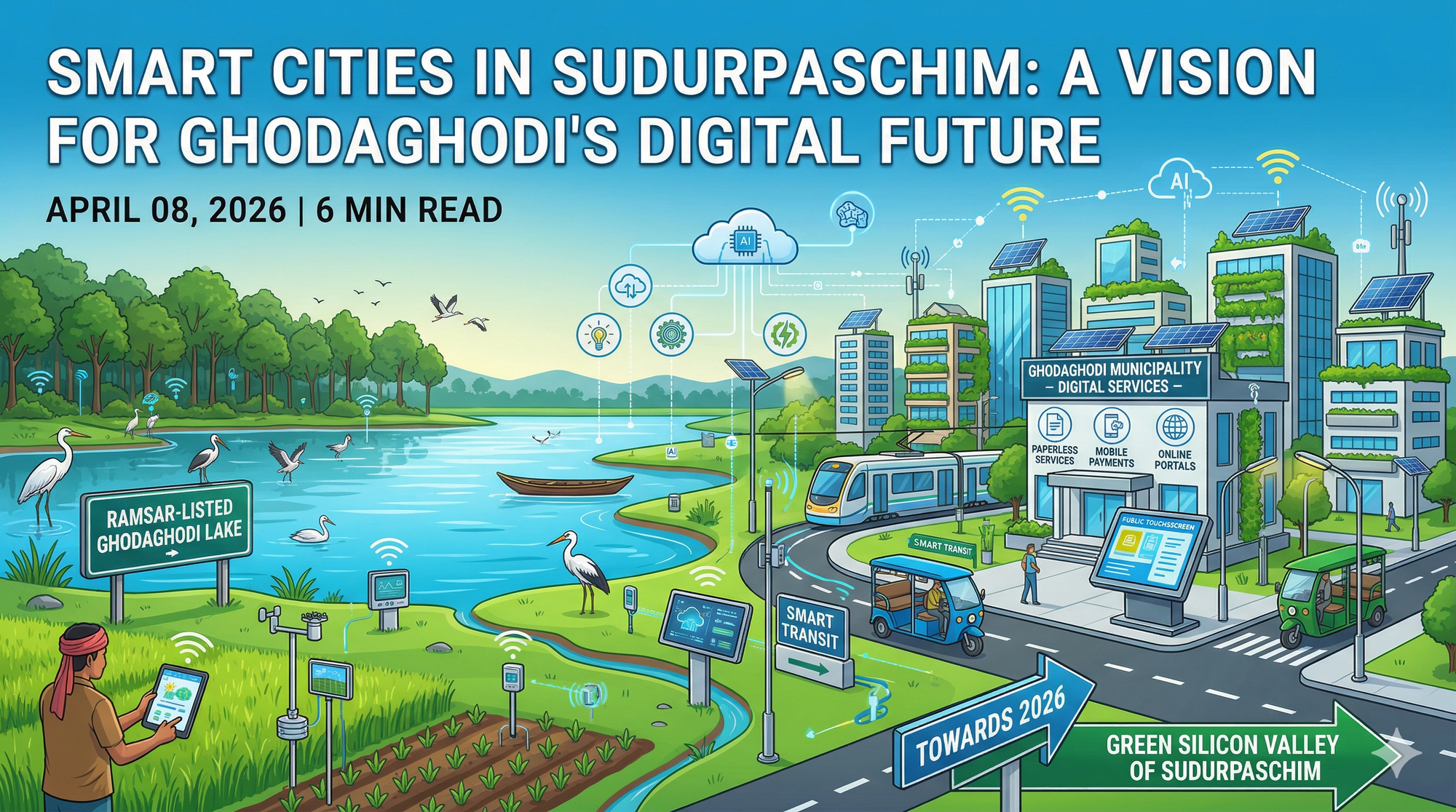
Smart Cities in Sudurpaschim: A Vision for Ghodaghodi's Digital Future
From gateway town to Green Silicon Valley: A roadmap for sustainable urban transformation in Nepal's Far-West.
Ghodaghodi is more than just a stop on the Mahendra Highway; it is the heart of Kailali and a gateway to the wonders of Sudurpaschim. For those of us who call this place home, we remember the Ramsar-listed lake that gives the town its name, the fertile fields that feed the region, and the bustling bazaar that connects the mountains to the plains.
But as we look toward 2026, the challenge is clear: How do we transition from rapid, unplanned urbanization to a Smart City model that preserves our natural beauty while empowering our citizens? How do we harness technology not as an imported luxury, but as a tool for local transformation?
A "Smart City" isn't just about high-speed internet or flashy apps; it's about using data and technology to improve the quality of life for everyone—from the farmer in the periphery to the shopkeeper in the bazaar. Here is my vision for how Ghodaghodi can lead the way in Sudurpaschim.
1. Digital Governance: The "Paperless" Ward Office
The foundation of a smart city is transparency. Currently, a citizen in Ghodaghodi Ward might need to visit the ward office five times for a single birth certificate recommendation—each visit an opportunity for delay, each delay a potential prelude to "facilitation fees."
The Vision: One Portal, All Services
Imagine a Ghodaghodi where essential services are accessible through a centralized digital portal:
| Service | Current Process | Smart City Model | Time Saved |
|---|---|---|---|
| Birth Certificate | 5+ office visits, paper forms, manual verification | Online application, hospital data integration, digital delivery | 3-5 days → 1 hour |
| Land Tax Payment | Travel to ward office, queue, cash payment, receipt collection | Mobile wallet payment, automatic ledger update, digital receipt | 1 day → 2 minutes |
| Business Registration | Multiple departments, unclear requirements, opaque timeline | Single-window digital platform, checklist transparency, progress tracking | 2 weeks → 3 days |
| Complaint/Grievance | Physical letter, unknown recipient, no tracking | Digital submission, automatic routing, public dashboard, resolution timeline | Unknown → Tracked |
The Impact: Removing Gatekeepers, Restoring Trust
By removing the physical "gatekeepers"—the officials who control information and extract rent for access—we reduce the opportunity for petty corruption. But more importantly, we restore dignity to the citizen-government relationship. The shopkeeper can focus on business; the farmer on crops; the student on studies—not on navigating opaque bureaucracy.
This builds directly on my previous post about The Digital Path to Transparency and how feedback-based apps can keep officials accountable.
Technical foundation: The Digital Rupee I have proposed elsewhere becomes the payment layer for these services—instant, traceable, corruption-resistant.
2. Smart Agriculture & The Ghodaghodi Lake Ecosystem
Ghodaghodi's identity is inseparable from its Ramsar-listed lake—a wetland of international importance that hosts migratory birds, supports fisheries, and maintains the region's hydrological balance. The town's name itself derives from this sacred water body: Ghoda (horse) Ghodi (mare), the legendary pair said to have discovered the lake.
A smart city must protect its environment even as it develops. Technology should not pave over nature; it should help us understand and preserve it.
The Vision: IoT for Ecology and Agriculture
| Technology | Deployment | Data Generated | Benefit |
|---|---|---|---|
| Water Quality Sensors | Ghodaghodi Lake and inflow streams | pH, dissolved oxygen, turbidity, temperature, pollutant levels | Early warning for contamination; migratory bird habitat protection |
| Soil Moisture Sensors | Peripheral agricultural zones | Real-time soil hydration, nutrient levels, salinity | Precision irrigation; water conservation; yield optimization |
| Weather Stations | Strategic locations across municipality | Micro-climate data: rainfall, humidity, wind, temperature | Localized forecasting; disaster preparedness; planting guidance |
| Wildlife Cameras | Lake perimeter and buffer zones | Species identification, migration patterns, population counts | Biodiversity monitoring; eco-tourism planning; conservation evidence |
Precision Agriculture for Kailali's Farmers
The farmers around Ghodaghodi currently irrigate based on intuition and tradition—sometimes over-watering, sometimes under-watering, always guessing. Smart agriculture changes this:
- Data-Driven Irrigation: Sensors detect exact soil moisture; automated systems deliver water only when and where needed—reducing usage by 30-40%
- Pest Prediction: Weather data models predict pest outbreaks; targeted intervention replaces blanket pesticide spraying
- Crop Optimization: Historical yield data plus soil analysis recommends optimal crops for each micro-zone
- Market Linkage: Digital platforms connect farmers directly to buyers, bypassing exploitative middlemen
The result: higher yields, lower costs, preserved ecology. The lake remains a sanctuary for migratory birds; the fields produce more with less; the farmers prosper without destroying the foundation of their prosperity.
3. Sustainable Urban Mobility
As Ghodaghodi grows—absorbing migration from the hills, serving as a commercial hub for western Terai—traffic congestion near the bazaar will become unmanageable. The current pattern of unplanned expansion, diesel vehicles, and chaotic parking will suffocate the town's livability.
The Vision: Solar-Powered, Data-Optimized Transport
| Infrastructure | Technology | Function | Impact |
|---|---|---|---|
| Solar Street Lighting | PV panels, LED fixtures, battery storage, smart controls | Automatic dusk-to-dawn lighting; dimming during low-traffic hours | Safer streets; 70% energy savings; grid independence |
| Digital Traffic Management | IoT sensors, AI optimization, variable message signs | Real-time congestion detection; dynamic signal timing; incident alerts | Reduced bottlenecks; faster emergency response; lower emissions |
| Public Transport Tracking | GPS on buses/e-rickshaws, mobile app, digital displays | Real-time location; arrival predictions; route optimization | Increased public transport use; reduced private vehicle dependence |
| Smart Parking | Ultrasonic sensors, mobile payment, dynamic pricing | Real-time space availability; cashless payment; demand management | Reduced circling traffic; revenue for municipality; better space use |
The bazaar that currently chokes with unregulated parking becomes a space for pedestrians. The roads that go dark at sunset become safe corridors for evening commerce. The buses that currently run empty "whenever" become reliable, tracked, trusted transport.
Energy autonomy: Solar-powered infrastructure aligns with Sudurpaschim's hydro and solar potential—locally generated, locally consumed, locally controlled.
The "Brain Gain" Connection: Global Skills, Local Roots
Building a smart Ghodaghodi requires a blend of local knowledge (understanding the lake's rhythms, the bazaar's dynamics, the community's needs) and global technical standards (IoT architecture, data security, urban planning). This is where the diaspora plays an irreplaceable role.
We cannot simply copy-paste a model from Melbourne or London. Those cities have different climates, different economies, different social fabrics. What works in a wealthy, cold, planned city may fail in a rapidly growing, tropical, organic town like Ghodaghodi.
Instead, we need adaptive innovation—taking the technical expertise developed abroad and translating it for local context:
| Expertise Developed Abroad | Ghodaghodi Application | Local Adaptation Needed |
|---|---|---|
| Smart City Planning (Australia) | Digital governance infrastructure | Offline capability for intermittent connectivity; Nepali-language interfaces; low-literacy UX design |
| IoT Engineering (USA/Germany) | Lake monitoring and agricultural sensors | Solar-battery power for grid-unreliable areas; ruggedized hardware for dust/monsoon; local maintenance training |
| Fintech Development (UK/Singapore) | Digital payment systems for bazaar merchants | Cash-out agent networks; interoperability with Indian payment systems for border trade; regulatory compliance |
| Renewable Energy (Scandinavia) | Solar street lighting and municipal power | Dust-resistant panel designs; anti-theft mounting; community ownership models |
As discussed in my post on Brain Drain vs. Brain Gain, the skills we acquire abroad are the "bricks" we use to build the infrastructure of our hometowns. Ghodaghodi doesn't need our sympathy; it needs our expertise.
The diaspora professional who returns—or contributes remotely—brings not just technical knowledge, but quality standards. They know what "good" looks like because they've seen it work elsewhere. They become the bridge between global best practice and local implementation.
Implementation Pathway: From Vision to Reality
Smart Ghodaghodi is not a 2050 fantasy; it is a 2026-2030 project. The pathway requires phased implementation, learning, and scaling:
- Phase 1: Foundation (2026)
- Digital governance portal for Ghodaghodi Municipality (3 highest-demand services)
- Solar street lighting pilot on main bazaar road
- Lake water quality sensor network (5 monitoring points)
- Diaspora technical advisory committee formation
- Phase 2: Expansion (2027-2028)
- Full digital service portfolio for municipality
- Smart agriculture rollout to 100 pilot farms
- Public transport GPS tracking and app launch
- Traffic sensor deployment and optimization
- Phase 3: Integration (2029-2030)
- Unified data platform connecting governance, environment, and mobility
- AI-powered optimization of municipal services
- Replication model for other Sudurpaschim municipalities
- Ghodaghodi as "Green Silicon Valley" recognition and investment attraction
Each phase builds on the previous, generating data, demonstrating value, and building the institutional capacity for the next level of sophistication.
Final Thought: The Green Silicon Valley of Sudurpaschim
Ghodaghodi has the potential to be something unique—not a clone of Western smart cities, but a "Green Silicon Valley" of Sudurpaschim. A place where technology serves ecology rather than paving over it. Where digital governance enables participation rather than surveillance. Where the diaspora returns not to escape the West, but to build something better than either West or traditional East.
We have the landscape—the lake, the fields, the mountains on the horizon. We have the location—the highway junction connecting Nepal and India, the hills and the plains. We have a generation of youth ready to lead, and a generation abroad ready to return.
All we need is the Digital Roadmap to get us there. This post is my contribution to that roadmap. The next steps require collective will: municipal commitment, provincial support, diaspora engagement, and citizen participation.
"The future of Nepal will not be built in Kathmandu alone. It will be built in towns like Ghodaghodi, by people who love this place enough to transform it."
What is the first "Smart" feature you would like to see in your hometown? Let's discuss below.