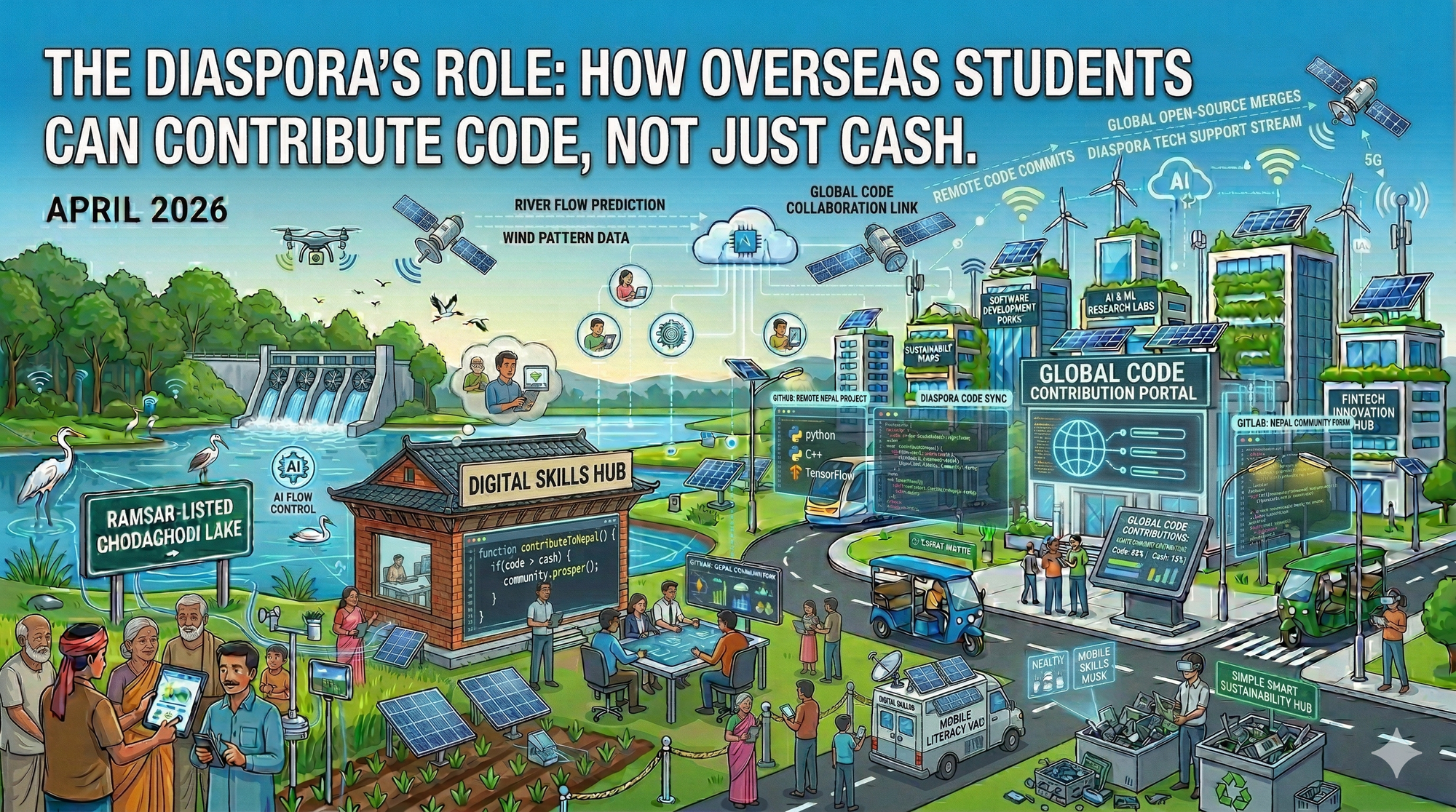
The Diaspora’s Role: How overseas students can contribute code, not just cash.
From remittance senders to repository contributors: Transforming Nepal's brain drain into collaborative innovation.
For decades, the Nepali diaspora's contribution to the homeland has been measured in dollars. Remittances—$8-10 billion annually—have sustained families, built houses, and kept the economy afloat. But as we move through 2026, a new form of contribution is emerging: code.
The Nepali student in Melbourne debugging an app at 2 AM, the developer in Silicon Valley contributing to open-source on weekends, the data scientist in London training models between lectures—these individuals represent an untapped reservoir of technical capital that can transform Nepal's digital infrastructure. Not through money sent home, but through commits pushed to repositories that power Nepali institutions.
This is the shift from financial remittance to intellectual repatriation. From consuming Nepal's education to build foreign careers, to leveraging foreign education to build Nepal's capacity. The tools for this transformation exist; what remains is the architecture to channel diaspora technical energy toward national priorities.
Beyond Remittances: The New Diaspora Contribution
The traditional model of diaspora engagement—earn abroad, send money home—has limitations:
| Dimension | Financial Remittance | Technical Contribution (Code) |
|---|---|---|
| Immediate Impact | High (consumption, debt payment, education) | Medium (requires implementation time) |
| Long-term Impact | Low (consumption-dependent; stops when sending stops) | High (persistent infrastructure; capacity building) |
| Multiplier Effect | Limited (individual household benefit) | Extensive (public infrastructure; shared benefit) |
| Skill Transfer | None (money carries no expertise) | Significant (code review, documentation, mentorship) |
| Sustainability | Dependent on diaspora income | Self-sustaining (local developers maintain and extend) |
| Diaspora Engagement | Transactional (sender-receiver) | Collaborative (peer relationships; community building) |
This is not an argument against remittances—families need support now. It is an argument for addition: that the diaspora's technical capacity, developed at foreign universities and honed in global companies, can be channeled alongside financial flows to build persistent national infrastructure.
For the broader framework on diaspora engagement, see my analysis of Brain Drain to Brain Gain. This post focuses specifically on the technical contribution pathway.
Contribution Models: How Code Reaches Nepal
Diaspora technical contribution operates through multiple channels, each suited to different skills, time commitments, and impact goals:
1. Open-Source Public Infrastructure
The most scalable model: diaspora developers contribute to open-source projects that Nepali institutions deploy and customize.
| Domain | Example Projects | Diaspora Role | Local Impact |
|---|---|---|---|
| E-Governance | Municipal service portals; tax systems; permit workflows | Core architecture; security review; documentation | Reduced corruption; faster services; SME enablement |
| Health Informatics | Hospital management; telemedicine platforms; vaccine tracking | FHIR standard implementation; AI diagnostic tools | Rural healthcare access; epidemic preparedness |
| Education Technology | Learning management systems; offline content delivery | Low-bandwidth optimization; multilingual interfaces | Rural digital literacy; quality education access |
| Agricultural Systems | Crop monitoring; market linkages; irrigation optimization | Machine learning models; satellite data integration | Farmer income increase; food security |
| Financial Infrastructure | Mobile banking; remittance platforms; CBDC integration | Blockchain development; security architecture | Financial inclusion; reduced remittance costs |
2. Remote Collaboration with Nepali Teams
Direct engagement where diaspora developers work alongside Nepali teams on specific projects:
- Code review and mentorship: Diaspora senior developers review code from junior Nepali developers, accelerating skill transfer
- Architecture consultation: Design reviews for complex systems (scalability, security, maintainability)
- Sprint participation: Part-time contribution to agile teams during critical development phases
- Quality assurance: Automated testing frameworks; security auditing; performance optimization
3. "Code for Nepal" Sprints
Structured events—virtual or in-person during visits—where diaspora developers concentrate effort on priority projects:
- Hackathons: 48-hour intensive development on specific challenges (disaster response, election monitoring, agricultural extension)
- Summer of Code programs: Structured mentorship matching diaspora professionals with Nepali student developers
- Documentation sprints: Critical but often neglected—translating technical documentation; creating user guides in Nepali
4. Startup Technical Co-Founding
Diaspora developers partner with Nepali entrepreneurs as technical co-founders—remote CTO roles for ventures addressing local markets:
- Technical architecture and initial development
- Remote team building and mentorship
- Investor connections and technical due diligence support
- Gradual transition to fully local technical leadership
Infrastructure Enablers: Making Collaboration Work
Effective diaspora code contribution requires supporting infrastructure—legal, technical, and social:
| Category | Current Barrier | Required Solution |
|---|---|---|
| Legal/Visa | No framework for remote work with Nepali entities; visa complications for visits | "Digital Nomad" visa category; tax clarity for remote technical income; volunteer work permits |
| Payment | Difficulty receiving payment for remote work; high forex costs for small contributions | Digital Rupee for instant settlement; micro-payment channels for bounty-style contributions |
| Technical | Time zone coordination; connectivity limitations for local partners; tool access disparities | Async-first collaboration protocols; development environment standardization; cloud resource subsidies |
| Social | Lack of trusted connection points; uncertainty about where contribution is needed; isolation from local context | Diaspora tech association chapters; project matching platforms; regular virtual "Nepal Tech" meetups |
| Recognition | No formal acknowledgment of contribution; no career benefit for volunteer technical work | Government/digital certificates; public contributor recognition; academic credit for student contributions |
Case Examples: Diaspora Code in Action
Concrete examples of how diaspora technical contribution has worked—or could work—for Nepal:
Case 1: The COVID-19 Dashboard
During the pandemic, a group of Nepali developers in the US, Australia, and UK collaborated remotely to build a real-time COVID-19 tracking dashboard for Nepal. The diaspora team handled data architecture, visualization, and server scaling; Nepali medical students and volunteers handled ground data collection and verification. The result: a critical public health tool built in weeks, not months, with zero government budget.
Case 2: Open Election Monitoring
For the 2022 local elections, diaspora developers contributed to an open-source platform for real-time result aggregation and visualization. The code—originally developed for a US municipal election—was adapted for Nepali electoral structures, with diaspora developers handling the technical heavy lifting and local CSOs managing deployment and observer coordination. The platform increased transparency and reduced result dissemination time from days to hours.
Case 3: Agricultural Price Information (Hypothetical 2026)
A Nepali graduate student in Melbourne develops a machine learning model for predicting vegetable prices at Kalimati market based on weather, transport, and seasonal patterns. She open-sources the model; a team in Kathmandu builds the SMS/WhatsApp delivery interface; farmers in Dhading subscribe and adjust planting decisions. The diaspora contribution: the core predictive algorithm, trained on global data but adapted for Nepali conditions. The local contribution: deployment, ground-truthing, and user support.
Call to Action: From Consumer to Contributor
For the Nepali student or professional abroad reading this, the question is: What are you building that Nepal could use?
The pathway from passive diaspora member to active contributor is not complex:
- Inventory your skills: What technologies do you work with daily? What problems have you solved that might have Nepali analogues?
- Identify the need: Connect with Nepali institutions, NGOs, or government bodies to understand their technical challenges. Join diaspora tech forums where needs are discussed.
- Start small: A bug fix, a documentation improvement, a code review. Build trust and understanding before major commitments.
- Find collaborators: Look for other diaspora developers with complementary skills; partner with local implementers who understand context.
- Commit to maintenance: Code that is abandoned creates burden. Ensure handover plans, documentation, and local capacity building.
For institutions in Nepal, the call is complementary: Make your technical needs visible. Document your requirements. Accept that diaspora contribution may be part-time and asynchronous. Invest in the relationship infrastructure that makes collaboration possible.
The IT outsourcing industry I have described elsewhere depends on this diaspora connection—not just as a source of contracts, but as a bridge of technical standards, quality expectations, and professional networks.
Conclusion: The Repository as Remittance
The Nepali diaspora has always been defined by duality: living abroad, belonging at home. For previous generations, this duality was managed through periodic return, through letters, through the money order sent monthly. For the current generation of technical professionals, there is a new medium: the git commit, the pull request, the deployed service.
Code is not just a technical artifact; it is a form of care. When a diaspora developer spends their weekend improving a Nepali hospital's patient management system, they are expressing a relationship to place that transcends geography. When they review code from a junior developer in Kathmandu, they are extending the mentorship they received in Sydney or San Francisco to the next generation at home.
This is the new remittance—the repository as relationship, the codebase as contribution. It does not replace financial support for families in need. But it builds something that money alone cannot: persistent infrastructure, transferred skills, and the foundation for a self-sustaining technical ecosystem in Nepal.
"Send money if you must. But also send commits. The code you write for Nepal today is the infrastructure your children will inherit."
Are you a diaspora developer contributing to Nepali projects? Share your experience. Are you a Nepali institution seeking technical collaboration? Describe your needs.