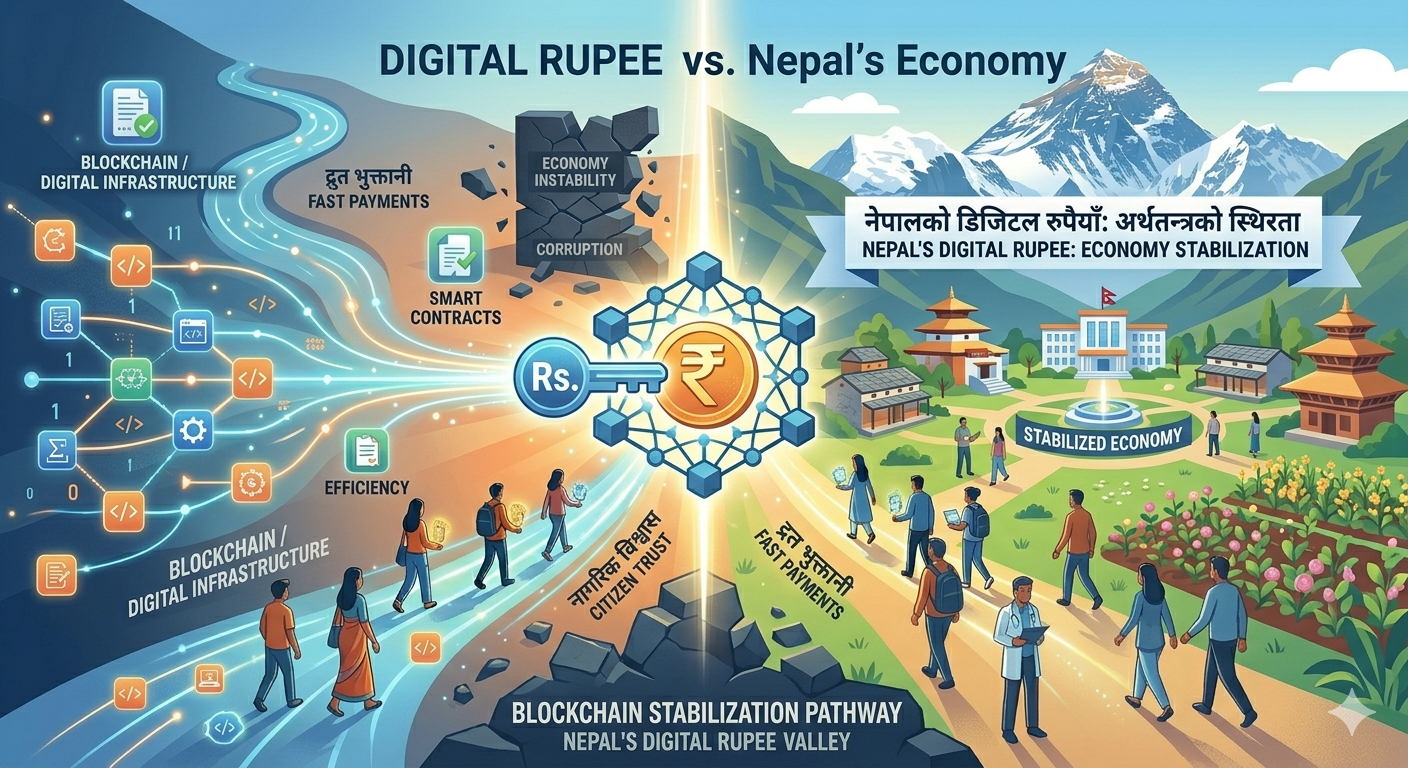
The Digital Rupee: How Blockchain Could Stabilize Nepal's Economy
From remittance dependence to monetary sovereignty: A blueprint for Nepal's financial transformation.
Nepal stands at a monetary crossroads. With $8-10 billion in annual remittances flowing through informal channels, a thriving parallel currency market along the Indian border, and limited monetary policy tools constrained by the peg to the Indian Rupee, the Nepal Rastra Bank faces a trilemma: maintain stability, enable growth, and preserve sovereignty.
The solution may lie not in traditional banking reform, but in blockchain-based central bank digital currency (CBDC)—a Digital Rupee that could transform Nepal from a remittance-dependent economy into a digitally sovereign financial hub. This is not speculation about distant futures; it is a practical roadmap for 2026-2030.
The Current Crisis: Nepal's Monetary Fragility
To understand why blockchain matters, we must first diagnose the structural weaknesses of Nepal's current monetary system:
| Problem | Manifestation | Economic Cost |
|---|---|---|
| Remittance Leakage | 40% of remittances flow through informal channels (hundi, cash couriers) | Lost forex reserves, unrecorded economic activity, no fiscal multiplier |
| Currency Peg Dependency | NPR pegged to INR at 1.6:1, limiting independent monetary policy | Cannot adjust rates to domestic conditions; imported Indian inflation |
| Financial Exclusion | Only 45% of adults have formal bank accounts; rural access minimal | Credit constraints for SMEs, savings vulnerability, limited tax base |
| Parallel Currency Markets | Border regions operate in INR; Terai has limited NPR penetration | Monetary sovereignty erosion, tax evasion, cross-border arbitrage |
These are not isolated dysfunctions; they are interconnected symptoms of a monetary architecture designed for a pre-digital era. The Digital Rupee addresses each simultaneously.
What is the Digital Rupee? Architecture and Distinction
The Digital Rupee is not cryptocurrency. It is a Central Bank Digital Currency (CBDC)—sovereign money issued by Nepal Rastra Bank, recorded on a permissioned blockchain, and accessible through mobile devices to every citizen with National ID verification.
Technical Architecture
| Component | Specification | Function |
|---|---|---|
| Blockchain Layer | Permissioned distributed ledger (Hyperledger/R3 Corda) | Immutable transaction record; real-time settlement; programmable money |
| Identity Layer | National ID (NID) biometric verification | KYC compliance; fraud prevention; financial inclusion |
| Access Layer | Mobile wallets (smartphone and USSD for feature phones) | Universal access; offline capability; agent banking integration |
| Interoperability | APIs for banks, remittance companies, government services | Seamless ecosystem; private sector innovation; fiscal integration |
| Monetary Control | Smart contracts for policy implementation | Automated stimulus; targeted subsidies; real-time monetary data |
CBDC vs. Cryptocurrency vs. Digital Banking
The distinction matters for policy and public understanding:
| Feature | Cryptocurrency (Bitcoin) | Digital Banking (eSewa) | Digital Rupee (CBDC) |
|---|---|---|---|
| Issuer | Decentralized algorithm | Private company | Nepal Rastra Bank |
| Backing | None (speculative) | Bank deposits | Full sovereign guarantee |
| Finality | Probabilistic (reversible) | Reversible (chargebacks) | Instant, irreversible settlement |
| Programmability | Limited | None | Smart contracts for policy |
| Offline Use | No | No | Yes (local Bluetooth) |
The Digital Rupee combines the innovation of blockchain with the stability of sovereign money. It is not an experiment; it is an upgrade.
Five Stabilization Mechanisms: How the Digital Rupee Transforms Nepal's Economy
1. Remittance Capture: From Leakage to Liquidity
Currently, 40% of Nepal's remittances bypass formal channels, flowing through hundi networks and cash couriers. This represents $3-4 billion annually that enters Nepal's economy without recorded trace—no forex reserves, no tax revenue, no fiscal multiplier.
The Digital Rupee changes the calculus:
- Instant Settlement: Migrant workers abroad can purchase Digital Rupee through partner exchanges, with value appearing in family wallets within seconds—not days
- Lower Costs: Blockchain settlement reduces remittance fees from 7-10% (traditional) to sub-1%
- Traceability: Every rupee enters the formal economy, expanding the tax base and enabling targeted policy
- Incentive Alignment: Families prefer Digital Rupee for immediate utility; workers prefer lower fees; government prefers visibility
For the diaspora professional considering how to channel expertise toward this transformation, see my reflection on Brain Drain to Brain Gain—the human infrastructure for monetary innovation.
2. Monetary Sovereignty Beyond the Peg
Nepal's currency peg to India (NPR 1.6 = INR 1) provides stability but eliminates independent monetary policy. When India raises rates to fight inflation, Nepal must follow—even if domestic conditions require stimulus.
The Digital Rupee creates policy space through programmability:
| Policy Goal | Traditional Tool | Digital Rupee Implementation |
|---|---|---|
| Stimulus Distribution | Bank rate cuts (slow, untargeted) | Direct Digital Rupee airdrop to NID-verified citizens; time-limited spending requirement |
| Regional Development | Block grants to provinces (leakage-prone) | Digital Rupee programmed for specific goods/services in target districts |
| SME Credit | Bank lending (collateral-constrained) | Digital Rupee credit lines with automated repayment from transaction flow |
| Capital Controls | Administrative restrictions (evadable) | Geofenced Digital Rupee; automatic conversion controls via smart contracts |
3. Financial Inclusion at Scale
With only 45% bank penetration and minimal rural branch presence, Nepal's unbanked population remains economically invisible—unable to save securely, access credit, or participate in formal markets.
The Digital Rupee is inclusion-native:
- Zero-cost accounts: Every NID holder automatically has a Digital Rupee wallet
- Agent networks: Local shops become "human ATMs" for cash-in/cash-out
- Offline capability: Bluetooth-based transactions work without internet in remote areas
- Micro-transactions: Divisible to 0.0001 NPR, enabling tiny payments (e.g., per-irrigation-use pricing)
4. Corruption-Resistant Public Finance
Public funds in Nepal face leakage at multiple levels: central to provincial, provincial to local, local to contractor, contractor to project. Each hand extracts; each delay enables diversion.
Digital Rupee enables programmable public expenditure:
A road construction budget in Sudurpaschim can be issued as Digital Rupee programmed to release only upon verified milestones—GPS-confirmed progress, biometric worker attendance, material delivery confirmation. The citizen feedback systems I have described elsewhere become verification oracles for smart contract release.
5. Cross-Border Trade Efficiency
Nepal's trade with India and China currently involves correspondent banking delays (3-5 days), high forex conversion costs, and documentary complexity. The Digital Rupee enables:
- Atomic swaps: Instant NPR-to-CNY or NPR-to-INR conversion via blockchain
- Smart trade finance: Automated letter-of-credit settlement upon IoT-verified delivery
- Tourism integration: Visitors purchase Digital Rupee at airports; seamless, traceable, tax-compliant
Implementation Roadmap: From Pilot to National Currency
The Digital Rupee is not a Big Bang replacement; it is a gradual migration:
| Phase | Timeline | Scope | Milestone |
|---|---|---|---|
| Phase 1: Wholesale | 2026-2027 | Interbank settlement only | NRB issues Digital Rupee to commercial banks; real-time gross settlement |
| Phase 2: Retail Pilot | 2027-2028 | Kathmandu Valley + 2 provinces | Citizen wallets; government salary payments; selected merchant acceptance |
| Phase 3: National Expansion | 2028-2029 | All 7 provinces | Universal NID-linked wallets; remittance corridors; full merchant network |
| Phase 4: Advanced Features | 2029-2030 | Full programmability | Smart contract policies; cross-border CBDC swaps; programmable subsidies |
Risk Mitigation
No monetary innovation is without risk. The Digital Rupee architecture addresses:
- Bank disintermediation: Digital Rupee complements rather than replaces banks; they become wallet providers and lending innovators
- Cybersecurity: Permissioned blockchain with NRB nodes; quantum-resistant cryptography; offline transaction limits
- Privacy: Tiered anonymity—small transactions private; large transactions traceable; policy-compliant
- Operational resilience: Distributed node architecture; satellite connectivity for remote areas; paper backup protocols
The Philosophical Dimension: Money as Social Technology
Beyond the technical and economic, the Digital Rupee represents a philosophical shift in how we understand money itself. In the Vedic tradition, Artha (material prosperity) is one of the four aims of life—but it must serve Dharma (righteous order).
Current monetary systems often obscure the relationship between economic action and social consequence. The Digital Rupee makes this relationship transparent and programmable:
For a deeper exploration of how technology can serve unity rather than division, see my reflection on Advaita Vedanta in the Age of AI—the philosophical foundation for technology that reveals interconnection rather than amplifying separation.
When every transaction is recorded on a shared ledger, when public funds flow through transparent channels, when monetary policy serves identified citizens rather than abstract aggregates—we move toward an economy that honors both efficiency and ethics.
Conclusion: The Digital Rupee as National Infrastructure
The Digital Rupee is not merely a payment innovation; it is monetary infrastructure for the 21st century. It addresses Nepal's specific vulnerabilities—remittance leakage, peg dependency, financial exclusion—while building on our unique strengths: high mobile penetration, diaspora connectivity, and the institutional opportunity of federalization.
The question is not whether Nepal can afford to implement the Digital Rupee. Given the $3-4 billion in annual remittance leakage, the question is whether we can afford not to.
"Money is a social technology. The Digital Rupee is Nepal's upgrade."
The Call to Action
Nepal Rastra Bank has begun CBDC research. The diaspora blockchain community, domestic fintech innovators, and policy advocates must now converge to ensure that when the Digital Rupee launches, it serves inclusion, stability, and sovereignty—not merely efficiency for the already-banked.
What role can you play in building Nepal's digital monetary future?