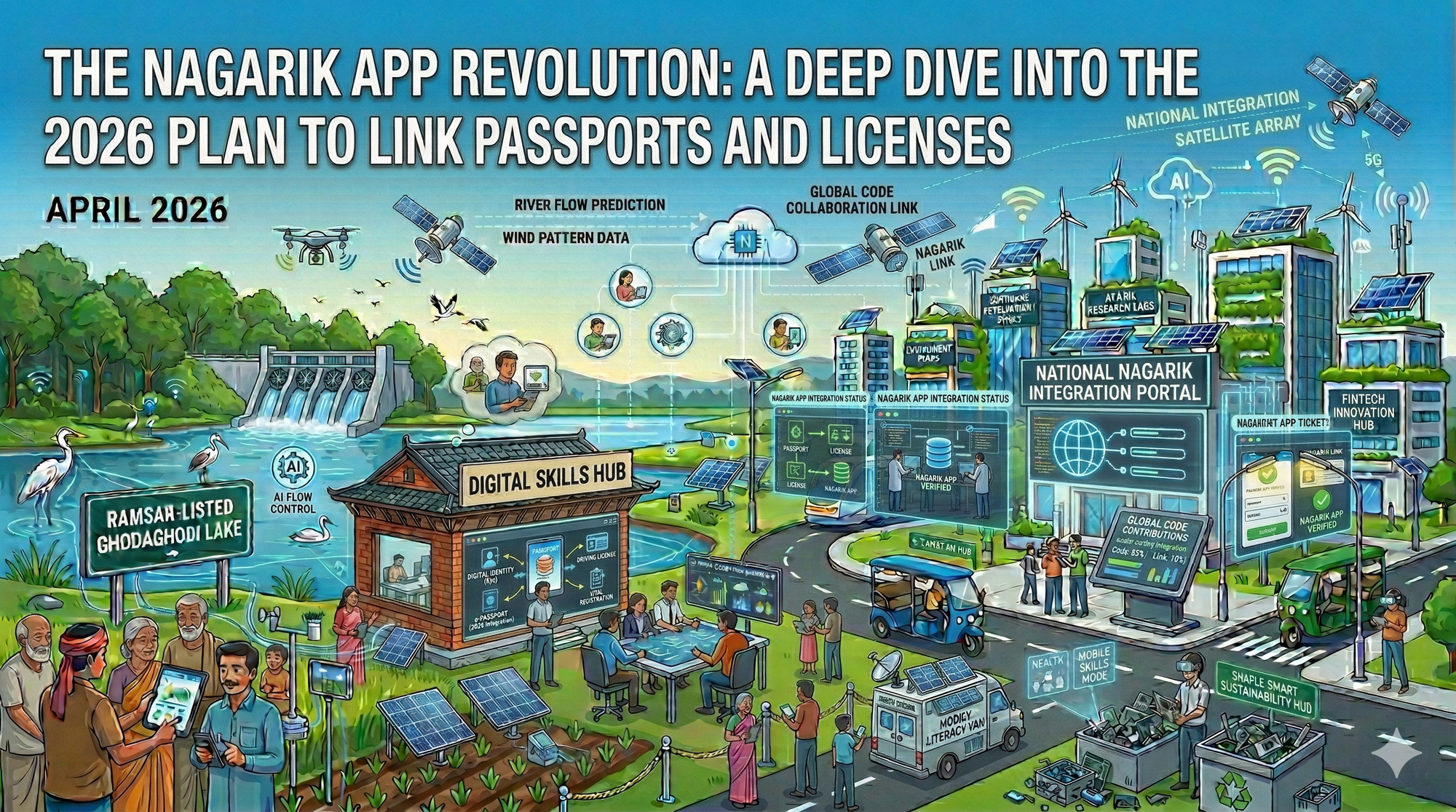
The Nagarik App Revolution: A deep dive into the 2026 plan to link passports and licenses into one integrated system.
How the 2026 roadmap is merging passports, licenses, and identity into a single digital ecosystem—and why this changes everything for the diaspora.
In the spring of 2026, Nepal's governance landscape is undergoing a seismic shift. The newly formed government has unveiled a 100-point good governance roadmap that places digital transformation at its absolute core. At the heart of this revolution is the Nagarik App—evolving from a simple portal into an integrated digital identity ecosystem that promises to unify passports, driving licenses, and citizenship documentation into a single, faceless, time-bound, trackable interface.
For the diaspora community and citizens alike, this is not merely technical convenience—it is structural liberation from the bureaucratic maze that has long defined the Nepali state-citizen relationship.
The 2026 Roadmap: From Promise to Platform
The government's 100-point action plan, approved in early April 2026, establishes aggressive timelines for digital integration:
| Phase | Timeline | Deliverable | Impact |
|---|---|---|---|
| Phase 1 | 45 Days (By May 2026) | Integrated application system for passport, driving license, and police clearance via Nagarik App | Single portal eliminates multiple office visits |
| Phase 2 | 100 Days (By July 2026) | Doorstep delivery of passports, citizenship certificates, and driving licenses via modernized courier service (all 77 districts) | Citizens receive documents without leaving home |
| Phase 3 | Immediate | 24-hour license printing upon data receipt; clearance of 2.9 million pending licenses | Elimination of multi-year backlogs |
| Ongoing | 2026-2027 | Mandatory National ID integration; auto-fill from centralized databases | No more duplicate form filling |
The "Faceless" Principle: The government has mandated that all services become faceless, time-bound, and trackable—meaning no physical presence at government offices, predictable processing timelines, and real-time status updates through the integrated system.
Technical Architecture: How the Integration Works
The Nagarik App is evolving from a simple interface into a sophisticated digital identity gateway:
1. Single Identity Backbone
The National Identity Card (NID) is becoming the mandatory single identification system. Recent interoperability has been established between the Centralized Citizenship Management Information System and the National Identity Management Information System—meaning data entered for citizenship automatically populates NID records, eliminating duplicate paperwork.
2. Auto-Fill Intelligence
When applying for passports or licenses through the Nagarik App, the system will auto-fill forms using:
- Details stored locally on the user's phone, OR
- Details obtained from other integrated government systems (DOPT, Passport Office, National ID Database)
Privacy Note: Importantly, the Nagarik App acts as a gateway rather than a central data repository—it facilitates access to distributed government databases without centralizing sensitive personal information.
3. QR Code Verification
Physical documents will feature encrypted QR codes containing citizen information. Verification no longer requires manual cross-checking—police, banks, and service providers can instantly validate identity, license status, or passport details through a scan.
| Document | Current Status | 2026 Target | Integration Method |
|---|---|---|---|
| Passport | Separate application; physical photos | In-app application; digital photos; QR verification | API integration with Passport Department |
| Driving License | 3.4 million backlog; manual processing | 24-hour printing; smart license with QR; digital certificate | DOPT data integration; automated workflow |
| Citizenship Certificate | Paper-based; ward office dependent | Digital download; doorstep delivery; NID-linked | Centralized Citizenship Database sync |
| Police Clearance | In-person application; long waits | In-app application; digital delivery; real-time tracking | Crime database integration |
The Diaspora Dimension: Code Not Just Cash
For overseas Nepalis, the Nagarik App Revolution represents a fundamental shift in how they interact with their homeland. The "Code Not Just Cash" paradigm becomes tangible here—this is infrastructure that requires technical expertise to build, maintain, and secure.
What Changes for the Diaspora
| Service | Previous Process (Overseas) | 2026 Digital Process | Time Saved |
|---|---|---|---|
| Passport Renewal | Travel to embassy/consulate; physical forms; photos; courier; weeks of waiting | In-app application; digital photo upload; trackable delivery | 2-3 weeks → 3-5 days |
| License Renewal | Must return to Nepal; medical test; queue at Yatayat; unclear timeline | Application via app; medical data integration; doorstep delivery abroad | Weeks → Days |
| Document Verification | Notarized copies; apostille; courier; physical verification | QR code verification; blockchain attestation; instant validation | Weeks → Instant |
The technical talent required to build and maintain this infrastructure—API developers, cybersecurity specialists, UX designers, blockchain architects—is precisely the expertise that diaspora students are acquiring abroad. The Nagarik App is not merely a convenience; it is a call to action for Brain Gain.
The Implementation Gap: Laws vs. Technology
Despite the technical readiness of the Nagarik App, a critical barrier remains: legal and institutional inertia. While the app can verify identity digitally, many institutions still demand physical documents because existing laws mandate paper-based verification.
| Barrier Type | Specific Issue | Impact | Solution Required |
|---|---|---|---|
| Legal Framework | Banks, hospitals, and government offices required by law to maintain physical document archives | Digital verification accepted informally but not legally; photocopies still demanded | Legislative amendments to recognize digital signatures and QR verification as legally binding |
| Institutional Inertia | Staff trained on paper-based verification; fear of accountability without physical files | Continued demand for photocopies despite digital alternatives; "old habits" in ward offices | Change management training; incentive realignment; feedback-based accountability |
| Connectivity Gaps | Remote municipalities lack reliable internet for real-time verification | Two-tier system where urban areas use digital, rural areas remain paper-based | Offline-capable app features; satellite connectivity for remote verification stations |
| Trust Deficit | Citizens fear digital fraud; confusion about data privacy; skepticism of "faceless" government | Low adoption despite technical availability; preference for "known" corrupt processes over "unknown" digital ones | Transparency campaigns; data protection legislation; digital literacy programs |
The government has recognized this gap—the Information Officer's meeting in February 2026 emphasized that merely launching the app is insufficient without addressing the underlying laws and institutional processes that demand physical documentation. The roadmap now includes legislative amendments to make digital verification legally equivalent to physical presence.
Economic Impact: The Cost of Waiting
The integration of passports and licenses into the Nagarik App is not merely administrative convenience—it is economic infrastructure:
- Time Savings: 2.9 million pending driving licenses represent millions of hours of lost productivity. Clearing this backlog unlocks labor mobility and economic participation.
- Remittance Efficiency: For the diaspora, streamlined document renewal means less time navigating bureaucracy, more time contributing productively. The Digital Rupee integration with Nagarik App could further streamline cross-border financial flows.
- Formalization: When documents are digital and trackable, the informal economy shrinks. Tax compliance improves. Planning becomes possible.
- Competitiveness: A country where citizens can verify identity and credentials instantly is more attractive for IT investment, international business, and tourism.
The Path Forward: From Application to Ecosystem
The Nagarik App Revolution is a test case for Nepal's broader digital transformation. Success here creates the template for e-governance, smart cities, and digital infrastructure across the nation.
Critical Success Factors for 2026
- Legislative Alignment: Amend the National ID Act, Passport Act, and Vehicle Act to recognize digital verification as legally binding. Without this, the app remains a convenience, not a replacement.
- Diaspora Technical Contribution: Engage overseas Nepali developers in security auditing, UX localization for multiple languages, and stress-testing the integration APIs. The code contribution must match the diaspora's cash remittances in value.
- Rural Inclusion: Ensure the 45% of Nepalis without smartphones can access services through assisted kiosks, SMS interfaces, and agent networks.
- Transparency: Publish APIs and documentation so civil society and the private sector can build complementary services, audit government performance, and ensure accountability.
"The Nagarik App is not just a portal. It is the digital front door of the Nepali state. When that door opens smoothly for every citizen, we will have achieved something no amount of concrete or steel could deliver: dignity through design."
Have you used the Nagarik App? What integrated service would most transform your interaction with the Nepali state? Share your experience below.