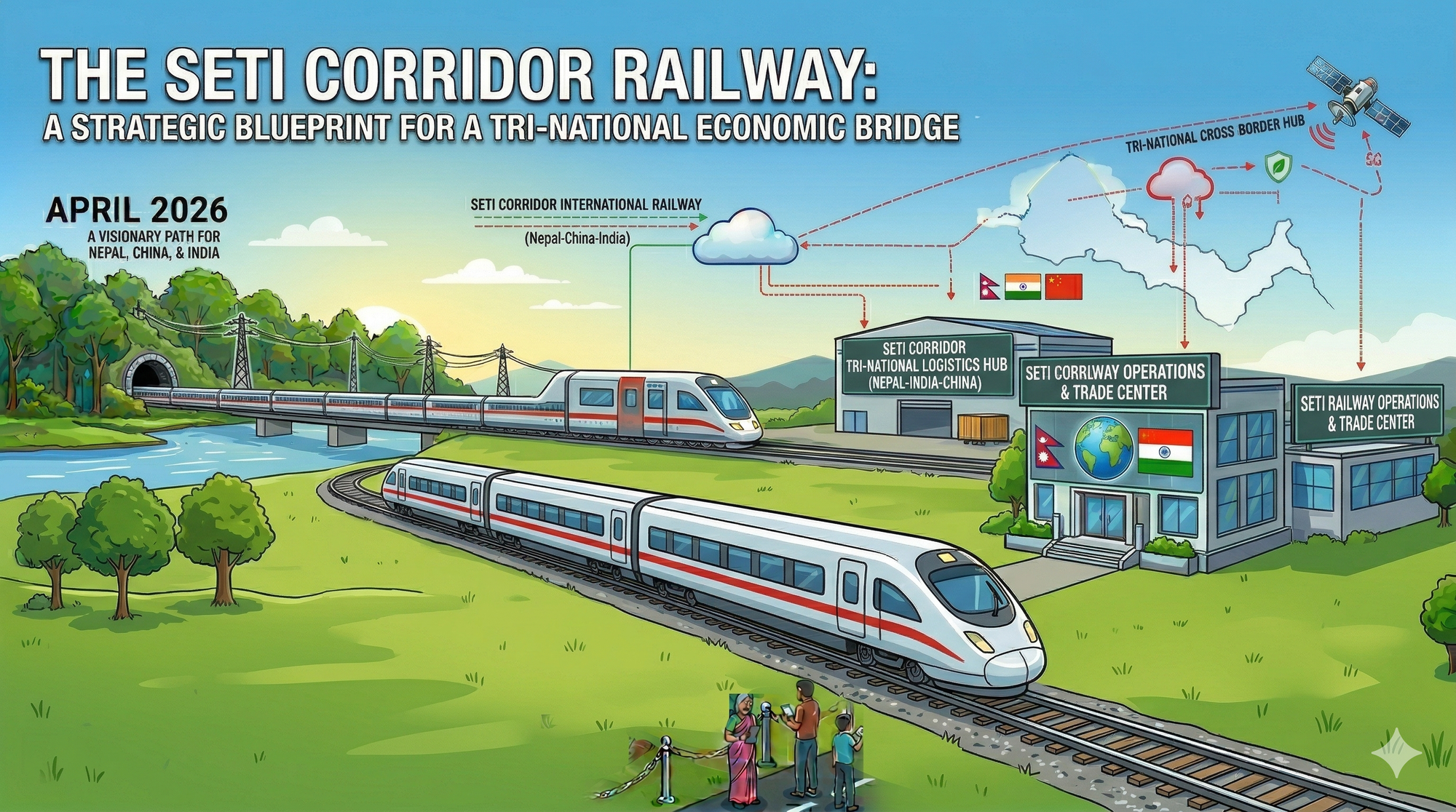
The Seti Corridor Railway:A Strategic Blueprint for a Tri-National Economic Bridge
Visionary Concept Paper
IMPORTANT NOTICE: This article is a personal conceptual framework and a strategic socio-economic vision authored by Laxmi Prasad Sapkota. It is NOT an official government project, a feasibility study commissioned by any authority, or a funded infrastructure initiative. It serves as a blueprint for what could be possible for Sudurpaschim through collective will and innovative engineering.
The Gaurifanta-Taklakot Rail Link: The Seti Axis
A 2026 Strategic Blueprint for Economic Sovereignty and Trilateral Connectivity.
1. The Strategic Thesis: Mastering the Nexus
Geography has historically been viewed as Nepal’s greatest constraint. For centuries, the Himalayan wall dictated isolation, and our reliance on southern ports created a vulnerability that limited our sovereign choice. However, in the infrastructure landscape of 2026, geography is no longer a prison—it is our ultimate leverage. The Seti Corridor is a unique geographic gift. It provides the most mathematically direct, lowest-gradient route connecting the massive industrial production centers of Northern India with the resource-rich Tibetan Plateau and the Eurasian landmass beyond.
The Trans-Himalayan Transit Corridor (THTC) is a conceptual proposal for a standard-gauge electric railway. It starts at the Gaurifanta/Tikuniya border—a point that already connects to the vast Indian rail network in Uttar Pradesh. It then carves a path through the heart of Sudurpaschim via the Seti River valley, breaching the Himalayas at Urai Bhanjyang, and terminating at the trade hub of Taklakot (Purang) in Tibet, China.
This vision aligns with the Trans-Himalayan Multi-Dimensional Connectivity Network, but focuses specifically on the "Far-West" potential. By building this axis, we transition Nepal from a "buffer state" into a "nexus state." We are no longer a country through which people travel to reach somewhere else; we become the marketplace where the world’s two largest populations exchange value. This is not just a railway; it is an assertion of Economic Sovereignty.
For this vision to succeed, it must be integrated into a broader digital and economic ecosystem. This includes our proposals for IT Outsourcing expansion and The Digital Rupee, ensuring that the physical movement of goods is matched by the digital movement of capital and information.
2. Engineering the Impossible: Tunnels and TBMs
Building a railway that rises from the 150-meter elevation of the Terai to the high-altitude passes of the Himalayas requires a departure from traditional Himalayan construction. We cannot rely on blasting methods that trigger landslides. This vision calls for precision heavy engineering utilizing state-of-the-art Tunnel Boring Machines (TBMs).
Technical Core: The TBM Strategy
The primary engineering challenge lies in the Himalayan Base Tunnel. To address this, we propose a "North-First" launch strategy. China already possesses massive logistical hubs and heavy-duty machinery—such as the Zhenhua TBMs—stationed near the Tibet-Nepal border. Launching the primary boring operations from the Tibetan side (Taklakot) allows the project to begin years earlier than waiting for a southern launch site to be reinforced.
However, to finish the project by the 2040 target, a Dual-Front Approach is possible. While the heavy machines move from the North, smaller, more agile TBMs can be deployed from the Doti/Bajhang side once the road infrastructure is upgraded to support their transport. The two teams meet in the middle, a feat of trilateral engineering cooperation.
- Seismic Resilience: The Seti valley is geologically active. TBM technology allows for immediate "segmented lining" where pre-cast concrete sections are installed to create a flexible, seismically-hardened shell.
- Hydrological Management: Using AI sensors along the TBM cutters, the system can predict high-pressure groundwater pockets before they are breached, preventing the catastrophic flooding common in Himalayan tunneling. This connects to our vision for AI-powered infrastructure management.
3. The Phased Rollout: A Strategic Sequence
A 240 KM mountain rail cannot be built in a single push. The project must provide incremental economic value at every stage.
Phase 1: The Northern Breach (Taklakot to Chainpur)
Focus: Tunnelling and the High-Altitude Link.
By starting from China, we utilize existing mechanical advantages. Once the Base Tunnel connects Taklakot to Chainpur (Bajhang), the project immediately unlocks the mineral wealth of the highlands. Chainpur becomes a high-altitude "Dry Port," where Himalayan organic products are loaded for rapid export to China, creating immediate cash flow for the province.
Phase 2: The Plains Portal (Gaurifanta to Dipayal)
Focus: Broad-Gauge Integration and the Terai Spine.
This phase can run simultaneously with Phase 1. It involves the least complex engineering but the highest administrative complexity regarding land acquisition. It links the Dhangadhi industrial zone with the regional capital at Dipayal. This immediately improves the provincial "ease of doing business" for SMEs in Sudurpaschim.
Phase 3: The Grand Completion (Dipayal to Chainpur)
Focus: High-Span Viaducts and Final Integration.
The middle segment is the most scenic and technically demanding, requiring extensive bridges across the Seti gorge. This completes the trilateral link, allowing a freight train from India to reach China in under 3 hours of transit within Nepal's borders.
4. Economic Multipliers: More than Just Freight
This corridor is designed to be a "Resource Nexus." It unlocks three sectors that have been stagnant due to transport costs:
A. Industrial Mining
Bajhang sits on high-grade limestone, copper, and copper-zinc deposits. A heavy-haul rail reduces the cost of mineral transport by 80%, making industrial mining ecologically and economically sustainable.
B. The Organic Agri-Export Engine
The Far-West can become the "Green Basket" for the Tibetan Plateau. Fresh organic produce, walnuts, and herbs can reach markets in Lhasa or Xining within hours via specialized cold-chain rail units.
C. Data Sovereignty: The Fiber Nexus
Every meter of rail track carries a parallel high-density fiber-optic backbone. The cold climate of the Seti gorge is the perfect place for Green Data Centers. We move from exporting water to hosting the world’s algorithms.
Technical & Strategic FAQ
(Click on a question to expand the technical answer)
+ What is the estimated capital expenditure (CAPEX)?
Based on 2026 benchmarks for high-altitude rail ($30M - $45M per KM), the 240 KM corridor is estimated between $7.5 Billion to $10 Billion USD. This includes the massive cost of the Himalayan Base Tunnel and the multi-gauge yards at Gaurifanta. Financing would be a trilateral Public-Private Partnership (PPP) involving sovereign wealth funds and international development banks.
+ How do Tunnel Boring Machines (TBMs) work in the Himalayas?
We propose "Gripper TBMs" for hard rock and "Shielded TBMs" for the fragile Siwalik soil. Unlike blasting, which creates micro-cracks in the mountain leading to future landslides, TBMs exert even pressure and provide immediate structural support. They can bore up to 500 meters per month, providing a deterministic timeline that blasting cannot guarantee.
+ What about the elevation difference and gradient?
The Seti Axis is chosen for its "Continuous Gradient" potential. By using Spiraling Tunnels inside the mountains, the engineering keeps the track slope below 2.5%. This is critical for heavy freight trains, allowing them to climb the Himalayas without the need for additional pusher locomotives, which would increase energy costs.
+ How do we span the deep Seti Gorges?
The vision calls for Cable-Stayed Railway Viaducts. These structures are flexible and highly resistant to the wind shear common in mountain valleys. By keeping the pillars widely spaced, we ensure zero disruption to the Seti River’s aquatic ecosystem.
+ What is the role of the West Seti Hydropower Project?
A high-frequency rail link requires ~250 MW of stable power. The West Seti Project (750 MW) acts as the "Power Plant" for the railway. This creates a high-value domestic consumer for our energy, reducing our dependence on electricity export prices and keeping the THTC’s carbon footprint at zero.
5. Integrity by Design: Solving the Corruption Problem
The greatest mountain we must cross is not physical, but institutional. To ensure every rupee reaches the ground, the THTC must be governed by Civic-Tech Oversight:
- Smart Contract Procurement: Every contractor and material supplier is paid via blockchain-verified smart contracts. Payments are triggered only when IoT sensors and citizen-powered monitoring apps verify that work is complete.
- Direct Compensation: Using the Digital Rupee, land compensation is paid directly to landowners, bypassing the middlemen who historically take a percentage of the people's wealth. This ensures the project has the full support of the local community.
- The "People's Audit": We propose a digital dashboard on this site where the diaspora community can conduct technical audits of construction data, using global standards to ensure transparency in Nepal.
2040: The Sudurpaschim Century
The Seti Corridor Railway is not just a dream of transit; it is the rebirth of a province. It is the moment Sudurpaschim stops asking for permission and starts providing the path. By 2040, this rail link could be the single most important piece of infrastructure in the Himalayas—a silent, electric bridge between civilizations.
"Our ancestors crossed these mountains with salt and wool on their backs. We will cross them with light and information at the speed of steel."
Do you believe Sudurpaschim is ready to be the Nexus of Asia? Join the blueprint discussion below.