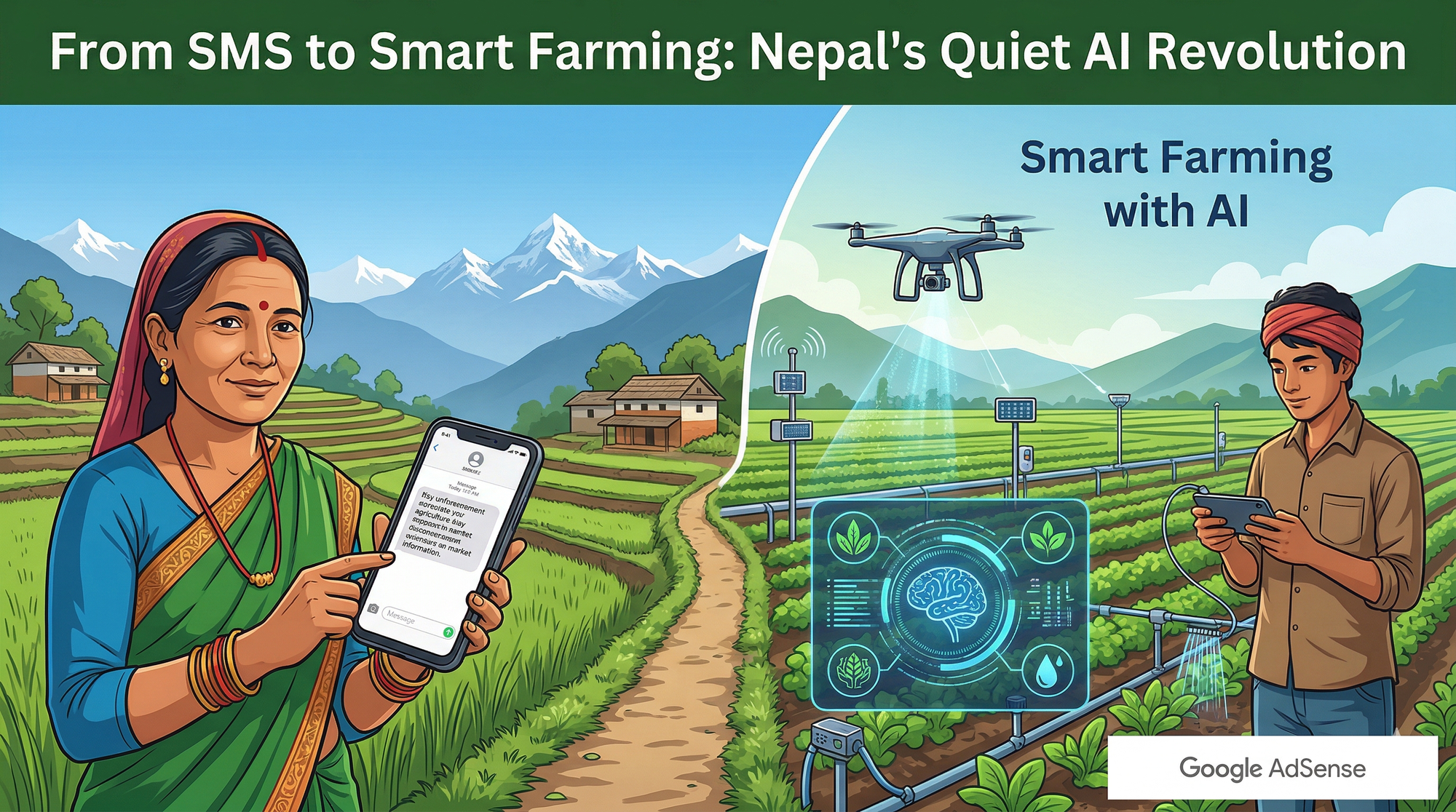
AI for Farmers: How a simple SMS-based AI can give market prices to rural villagers in Nepal.
How a simple text message could change the income of millions of farmers
🌾 The Real Problem: Information Gap, Not Effort
In Nepal, farmers are not poor because they don’t work hard. They are poor because they don’t have real-time information.
A tomato farmer in Kavre might sell produce at NPR 25/kg, while the same tomatoes are being sold for NPR 60/kg in Kalimati Bazaar. The difference? Not quality. Not effort. Just lack of market awareness.
Even in 2026, many rural farmers still rely on:
- Word of mouth
- Local middlemen (bicholiya)
- Outdated price assumptions
And this is where something surprisingly simple — SMS-based AI — can become revolutionary.
📲 What is SMS-Based AI for Farmers?
Imagine this: A farmer sends a simple SMS:
"Tomato price Kathmandu"
Within seconds, they receive:
- Current wholesale price
- Retail market trend
- Demand forecast (high/low)
- Suggested best selling location
No smartphone. No internet. No apps. Just a basic phone.
This system uses AI + local data + telecom infrastructure to convert complex market data into simple, understandable SMS responses.
🧠 Why SMS Still Matters in 2026 Nepal
Let’s be realistic. While urban Nepal is moving towards apps and AI tools, rural Nepal still operates differently:
- Internet access is inconsistent
- Smartphones are not universal
- Digital literacy is still growing
But one thing is everywhere:
📡 Mobile network + SMS capability
This is why SMS-based AI is not a “backup solution”—it is the most practical first solution.
In fact, this directly connects to the broader challenge discussed in Digital Literacy in Rural Nepal, where accessibility—not innovation—is the real bottleneck.
💰 How This Impacts Farmer Income (Real Example)
Let’s break it down with a simple scenario:
| Scenario | Without AI | With SMS AI |
|---|---|---|
| Tomato Selling Price | NPR 25/kg | NPR 50/kg |
| Monthly Sales | 500 kg | 500 kg |
| Total Income | NPR 12,500 | NPR 25,000 |
Same effort. Same land. Same farmer.
Income doubled — just by having information.
⚙️ How the System Actually Works
Behind the scenes, this is not magic—it’s a smart combination of technologies:
- Data collection from markets like Kalimati, Pokhara, Biratnagar
- AI models predicting price trends
- Integration with telecom providers (NTC, Ncell)
- Language processing in Nepali and local dialects
For example, the AI system can interpret:
- "Aalu bhau?" → Potato price
- "Dhan ko rate?" → Paddy price
And respond in simple Nepali SMS:
"Aaja Kalimati ma aalu ko wholesale rate NPR 42/kg. Demand medium cha."
This aligns with Nepal’s growing digital ecosystem, similar to how the Nagarik App is simplifying government services.
🌍 Global Proof: This Model Already Works
Nepal is not starting from zero. Similar systems have already shown success globally:
- India: eNAM platform provides digital market pricing
- Kenya: iCow uses SMS for farming advice
- Bangladesh: SMS crop advisory services boosted yields
According to the Food and Agriculture Organization (FAO), access to market information can increase farmer income by up to 30%.
And Nepal? We are perfectly positioned to adopt this—especially with our strong telecom penetration.
🚧 Challenges We Must Solve
Of course, it’s not as simple as launching a system and walking away.
Key challenges include:
- Data accuracy from local markets
- Trust building among farmers
- Language and dialect variations
- Government and private sector coordination
This is where governance matters. As highlighted in Lessons in Local Governance, transparency and accountability are critical for systems like this to succeed.
🚀 The Bigger Vision: Beyond Prices
Today, SMS AI can give prices.
Tomorrow, it can provide:
- Weather alerts
- Pest outbreak warnings
- Fertiliser recommendations
- Crop planning suggestions
Imagine a farmer receiving:
"Heavy rain expected in 48 hours. Harvest maize early."
That’s not just information—that’s risk prevention.
And if connected with financial tools, it could even guide farmers on savings, linking indirectly to ideas like those discussed in why idle money loses value over time.
🇳🇵 Why This Matters for Nepal’s Future
Agriculture still employs over 60% of Nepal’s population.
If we improve farmer income even slightly:
- Rural poverty drops
- Migration slows down
- Local economies strengthen
This is not just a tech solution—it is a national development strategy.
And the best part?
It doesn’t require billion-dollar investment.
Just smart integration of what we already have.
🧑💻 The Opportunity for Nepali Youth
Here’s the hidden layer most people miss:
This system can be built by Nepali developers.
- AI engineers
- Data analysts
- Telecom integrators
Diaspora students, especially those in Australia, can contribute remotely—exactly the kind of impact discussed in The Diaspora’s Role.
This is how we turn brain drain into brain gain.