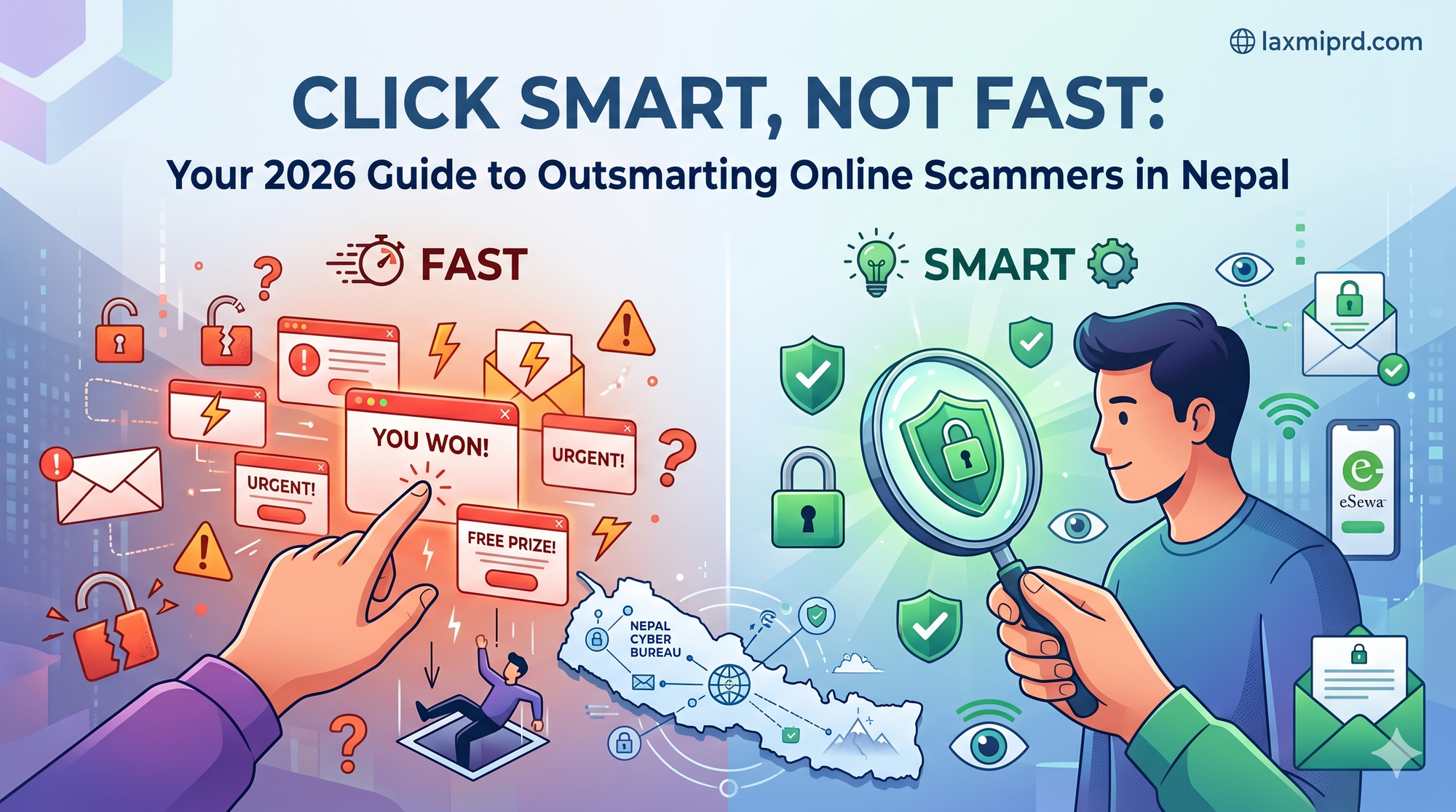
How to Avoid Online Financial Scams: A safety guide for new internet users in Nepal
Because one wrong click can cost more than a month’s salary.
In 2026, Nepal is more connected than ever. From TikTok shops to online banking, from eSewa transfers to NEPSE investments—our digital life is growing fast. But here’s the uncomfortable truth: scammers are growing faster.
If you are a new internet user—or even someone who just recently started using mobile banking—this guide is for you. No complicated jargon. No “tech expert” tone. Just real, practical advice that can save your hard-earned money.
And yes, this isn’t just theory. These scams are happening right now in Kathmandu, Pokhara, Dhangadhi—and even in rural villages where internet just arrived last year.
Why Nepal Is Becoming a Target for Online Scams
Let’s be honest. Nepal is in a digital transition phase. Millions of people are coming online for the first time. That creates a perfect opportunity for fraudsters.
- Low digital literacy in rural areas
- Rapid adoption of mobile wallets
- Growing interest in share market (NEPSE)
- Lack of awareness about data privacy laws
According to Nepal Rastra Bank (NRB), digital transactions have increased massively—but fraud complaints are also rising.
This is why understanding scams is no longer optional—it’s survival.
The Most Common Online Scams in Nepal (2026 Edition)
| Scam Type | How It Works | Real Risk |
|---|---|---|
| Fake Job Offers | “Pay NPR 2,000 for registration” | Lose money, no job |
| Phishing SMS/Emails | Fake bank links asking login details | Account drained |
| Social Media Giveaways | “You won an iPhone!” | Data theft or payment trap |
| Fake Investment Schemes | “Double money in 30 days” | Total loss |
Especially in NEPSE-related scams, many beginners confuse investing with gambling. If you want clarity, read this: Risk vs Gambling: Why the Share Market is a Business
Red Flags: How to Spot a Scam Instantly
Think of this as your “digital sixth sense.” If you notice even one of these, pause immediately.
1. Too Good to Be True?
If someone promises:
- Guaranteed profit
- Free money
- Instant job abroad
It’s almost always fake.
2. Urgency Pressure
“Act now or lose your chance!” This is psychological manipulation. Real institutions don’t rush you.
3. Unknown Links
Never click links from unknown SMS or Facebook messages. Even if it says “NRB” or “Bank of Kathmandu.”
4. Asking for OTP or Password
No bank in Nepal will ever ask for your OTP.
Real-Life Scenario: A Typical Scam in Nepal
Let’s make it real.
A person in Butwal gets a Facebook message:
“Congratulations! You have won NPR 50,000 from Daraz Lucky Draw. Click here to claim.”
They click → enter phone number → receive OTP → enter OTP → BOOM.
Within minutes, their eSewa wallet is empty.
This is not rare. This is happening daily.
Smart Habits That Protect You (Even If You’re Not Tech-Savvy)
1. Use Official Apps Only
Download banking apps only from Google Play Store or Apple App Store. Never from random links.
2. Double-Check URLs
Fake sites look real. Always check spelling like:
- esewa.com.np ✔
- esewa-login-free.xyz ✘
3. Enable Two-Factor Authentication
This adds a second lock to your account.
4. Don’t Overshare on Social Media
Your phone number, birthday, school—these are tools for scammers.
5. Stay Updated on Digital Rights
Nepal is evolving in digital governance. Understanding your rights matters. Read: Nepal’s Personal Data Protection Policy 2082
Special Warning: Investment & “Easy Money” Scams
In Nepal, many people are entering the financial world for the first time.
But here’s the dangerous mindset:
“I want fast money.”
This is exactly what scammers target.
If someone tells you:
- “Invest NPR 10,000, get NPR 50,000 in a week”
- “Crypto trading guaranteed profit”
Stop right there.
Even safe investments like IPOs require patience. If you’re new, this is a must-read: IPO: The Safest Entry into the Market
What To Do If You Get Scammed
Don’t panic—but act fast.
- Immediately call your bank or wallet provider
- Block your account if needed
- Report to Nepal Police Cyber Bureau
- Inform family/friends to prevent further spread
The faster you act, the higher the chance of recovery.
The Bigger Picture: Digital Literacy Is the Real Solution
This isn’t just about avoiding scams. It’s about building a smarter Nepal.
As more services go online—from Nagarik App to digital banking—our responsibility also increases.
Digital literacy is not just for IT students. It’s for:
- Farmers in Kailali
- Housewives in Biratnagar
- Students in Kathmandu
For deeper insight into this transformation, explore: Digital Literacy in Rural Nepal
Final Reality Check
Scammers don’t hack systems—they hack people.
You don’t need to be a tech expert to stay safe. You just need awareness, patience, and one simple habit:
Think before you click.
Because in today’s Nepal, your phone is not just a device—it’s your bank, your identity, and your future.
:contentReference[oaicite:0]{index=0}