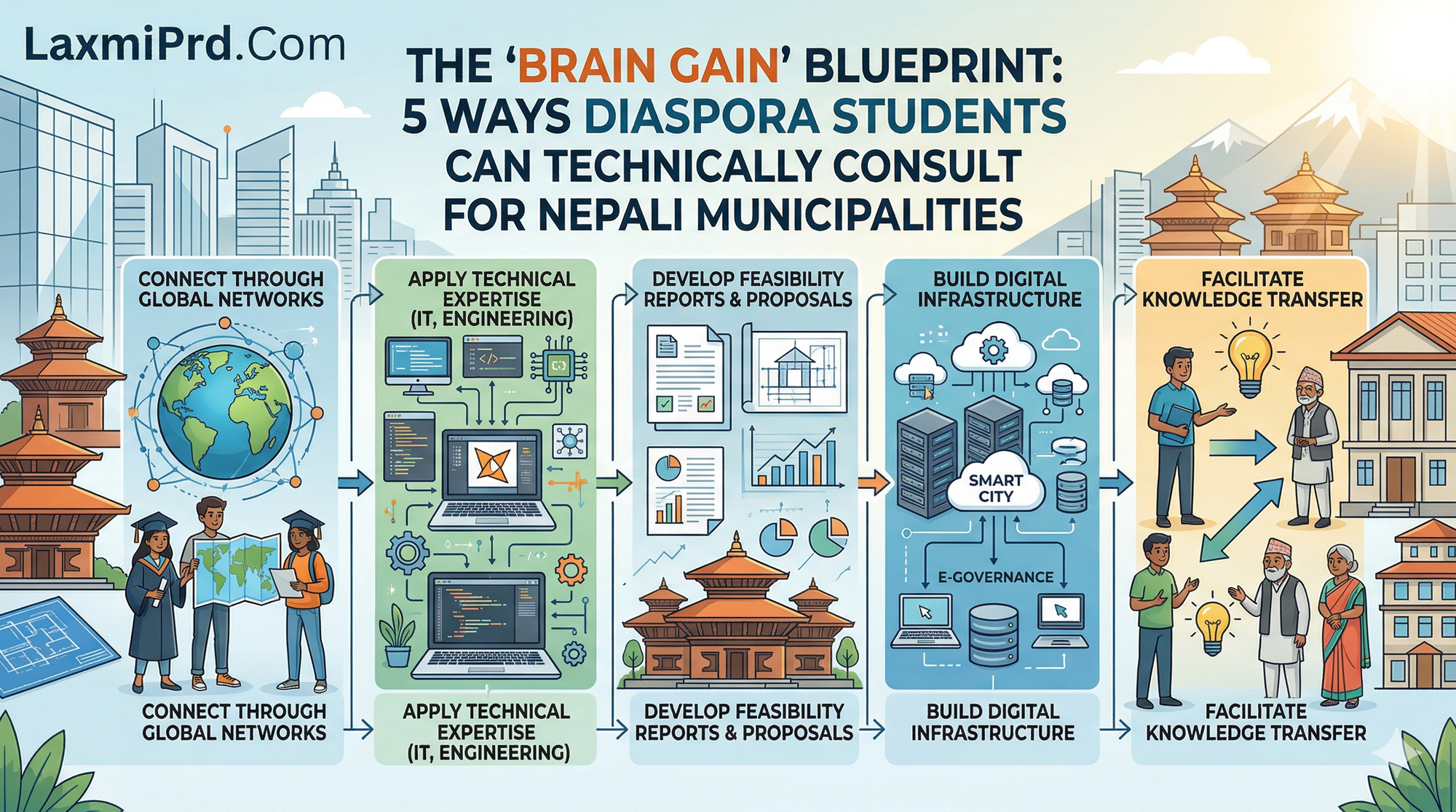
The "Brain Gain" Blueprint: 5 ways diaspora students can technically consult for Nepali municipalities
How Nepali diaspora students can turn Wi-Fi into nation-building—without boarding a flight
In 2026, Nepal doesn’t just have a brain drain problem—it has an untapped remote talent advantage. Thousands of Nepali students are studying in Australia, the UK, Canada, and beyond. They are learning software development, data analysis, urban planning, cybersecurity, and finance—skills that many municipalities in Nepal urgently need.
The twist? You don’t need to “return home” to contribute.
This is where the idea of “Brain Gain” becomes practical—not emotional. Not patriotic slogans, but technical consulting. Real deliverables. Real value. Paid or unpaid, small or scalable.
Let’s break down 5 practical ways diaspora students can technically consult for Nepali municipalities—even from a shared apartment in Melbourne or a student dorm in London. :contentReference[oaicite:0]{index=0}
1. Build Simple Digital Systems That Replace Paper Chaos
Walk into most municipal offices in Nepal today, and you’ll still see:
- Handwritten records
- Manual file tracking
- Queues for basic services
This is not a “lack of intelligence” problem. It’s a lack of systems.
As a diaspora student, you can consult by building:
- Online grievance portals
- Property tax tracking systems
- Permit application dashboards
- Basic CRM tools for citizen requests
You don’t need to build the next Silicon Valley startup. Even a Google Sheets + AppScript + simple web frontend can outperform current workflows.
This aligns directly with Nepal’s push toward digital governance. If you’ve read e-governance in Nepal, you’ll notice one key insight: digitisation is not about fancy apps—it’s about reducing friction.
Real example idea: A ward office in Kailali could use a simple system where citizens submit requests online instead of physically visiting 3 times.
2. Use Data to Help Municipalities Make Smarter Decisions
Most municipalities in Nepal don’t lack data—they lack data interpretation.
They collect:
- Population records
- Tax payments
- Infrastructure costs
- Education and health statistics
But what they don’t have is someone asking:
“What is this data telling us?”
If you’re studying IT, business analytics, or engineering, you can:
- Clean messy datasets
- Create dashboards (Power BI, Tableau, or even Excel)
- Identify inefficiencies (e.g., where budget leaks happen)
- Predict trends (like migration patterns or service demand)
Think about this: If a municipality could predict which areas need road repair before complaints pile up, it saves both money and public frustration.
This is how countries like Australia operate—data first, decisions second.
3. Help Design Smart Infrastructure—Digitally First
Infrastructure in Nepal is often built like this:
“Let’s build now, think later.”
But diaspora students can flip this model.
If you’re in civil engineering, IT, or urban planning, you can consult remotely on:
- GIS mapping of roads and utilities
- Smart traffic planning
- Digital layouts before physical construction
- Simulation models (flood risk, road congestion)
This becomes even more powerful when linked with national-scale ideas like the Seti Corridor vision—where local infrastructure connects to international trade routes.
Key mindset shift: You’re not just “helping your hometown.” You’re helping design economic corridors.
4. Strengthen Cybersecurity and Data Protection at Local Level
As Nepal digitises, a new risk emerges: data vulnerability.
Municipal systems—if poorly secured—can be exposed to:
- Data leaks
- Unauthorized access
- System manipulation
This is where diaspora IT students can step in:
- Conduct basic security audits
- Set up authentication systems
- Train staff on phishing awareness
- Recommend secure cloud practices
With policies like Nepal’s emerging digital frameworks, including data protection laws, this is no longer optional—it’s essential. (See Nepal’s Personal Data Protection Policy 2082.)
Reality check: A single vulnerability in a municipal system can expose thousands of citizens’ personal data.
5. Create Micro-Consulting Models: Small Work, Big Impact
Here’s where most diaspora students get stuck:
“I don’t have time.”
Fair. You’re studying, working part-time, managing rent, surviving abroad.
So don’t think big. Think micro-consulting.
Examples:
- 2-week project: Fix a ward office’s Excel system
- 1-month project: Build a simple website
- Weekend work: Design a digital form system
- Remote workshop: Train municipal staff via Zoom
This is not charity. This can evolve into:
- Freelance income
- Portfolio projects
- Long-term contracts
- Startup ideas
This idea connects strongly with the philosophy in “code, not just cash”—because remittance alone doesn’t build systems.
Important shift: You are not a donor. You are a technical partner.
Why This Matters in 2026 Nepal
Nepal is at a strange but powerful crossroads:
- Rapid digital adoption (apps like Nagarik App expanding)
- Increasing youth migration
- Local governments gaining more authority
- Rising internet penetration even in rural areas
But here’s the gap:
Execution capacity at the local level is still weak.
This is exactly where diaspora students fit in.
You understand:
- How systems work in Australia
- How inefficient processes feel in Nepal
- How to bridge both worlds
That combination is rare—and valuable.
Even global institutions like the World Bank and UNDP emphasise local governance capacity building as a core development strategy.
The Hidden Opportunity: From Student to System Builder
Most students think like this:
Study → Graduate → Job → PR
But a smarter path looks like:
Study → Apply Skills Remotely → Build Portfolio → Create Impact → Then Choose Where to Live
This is how you turn “brain drain” into location-independent influence.
You’re no longer just part of the Nepali diaspora.
You become part of Nepal’s distributed development engine.