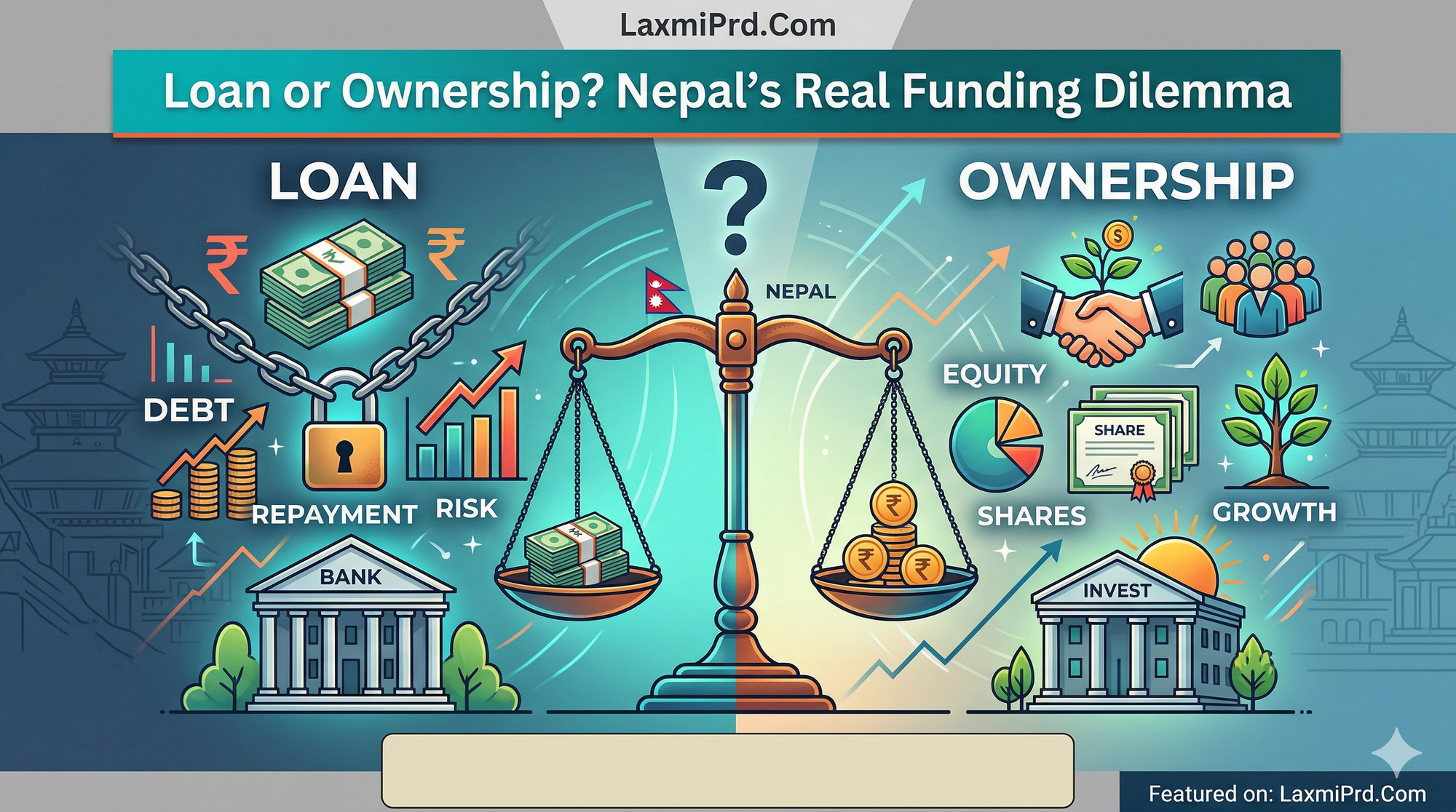
Loan or Ownership? Nepal’s Real Funding Dilemma
Why the future of national pride projects depends on who pays—and who truly owns
It’s 2026, and Nepal stands at an interesting crossroad. On one side, we have the familiar path—foreign debt. Big loans, quick infrastructure, and long-term repayments. On the other side, there’s a quieter but powerful idea gaining traction—Citizen IPO funding. Projects funded not by outsiders, but by the people themselves.
This isn’t just an economic debate. It’s about identity. About whether Nepal builds its future on borrowed money—or shared ownership.
If you’re a lower-middle class Nepali—earning, saving, maybe thinking about your first investment—this conversation directly affects you. Because the question is simple:
Should Nepal take loans… or invite you to become an owner?
Understanding Foreign Debt: Fast Money, Slow Pressure
Foreign debt is not new to Nepal. From hydropower to highways, loans from institutions like World Bank and Asian Development Bank have helped build critical infrastructure.
At first glance, it sounds practical. Nepal gets funding quickly. Projects begin. Roads are built. Electricity flows.
But here’s the hidden layer most people don’t think about:
- The loan must be repaid—with interest.
- The repayment often stretches across decades.
- The burden eventually falls on taxpayers—meaning you.
Think about it like this: Imagine building a house with a loan you’ll repay for 30 years. Now imagine your children continuing to pay that loan. That’s how national debt works.
And if projects don’t perform as expected? The debt still remains.
Nepal’s public debt has been steadily increasing, and while it is still within manageable limits, the risk is not immediate collapse—it’s long-term dependency.
The more we rely on loans, the less control we have over our own economic direction.
Citizen IPO Model: Turning the Public into Owners
Now let’s flip the perspective.
Instead of borrowing billions from outside, what if Nepal raised capital from its own people—through IPOs?
Yes, the same system you see in NEPSE today—but applied to national pride projects.
In this model:
- The government retains majority control (say 51%)
- The remaining shares (49%) are offered to citizens
- People invest and become partial owners
- Profits are shared—not exported
This idea connects deeply with financial literacy. If you’ve ever wondered whether IPOs are safe or meaningful, you might enjoy this perspective: IPO: The First-Class Ticket.
The key shift here is psychological:
From taxpayer → to shareholder.
And that changes everything.
Real-World Example: What Could This Look Like?
Let’s bring this closer to home.
Imagine a project like the Seti Corridor Railway—one of the most strategic infrastructure ideas for Nepal’s future trade.
Instead of funding it entirely through foreign loans, the government launches a public IPO.
Suddenly:
- A teacher in Dang invests NPR 10,000
- A migrant worker in Australia invests NPR 1 lakh
- A small shop owner in Pokhara invests NPR 5,000
Now multiply that across millions of citizens.
The capital adds up. But more importantly, the ownership spreads.
If you’re curious about the strategic importance of such a project, this breakdown adds more context: Seti Corridor Railway Explained.
Now imagine that same project generating revenue through freight, tourism, and logistics. Instead of profits going abroad, they return to Nepali households.
Foreign Debt vs Citizen IPO: A Clear Comparison
| Factor | Foreign Debt | Citizen IPO Model |
|---|---|---|
| Ownership | External lenders influence | Owned by citizens |
| Repayment | Mandatory with interest | No repayment—profit sharing instead |
| Economic Impact | Outflow of capital | Circulation within Nepal |
| Public Engagement | Low | High |
| Risk Distribution | Government bears most risk | Shared among citizens |
But Let’s Be Honest: IPO Model Isn’t Perfect Either
Before we get too idealistic, let’s ground this.
Citizen IPO funding comes with its own challenges:
- Low financial literacy in rural areas
- Trust issues with governance
- Market volatility (NEPSE isn’t always stable)
- Risk of politicisation
And this is where mindset matters.
If people treat IPOs like gambling, the system fails. But if they treat it like long-term ownership, it becomes powerful.
This difference is beautifully explained here: Risk vs Gambling in NEPSE.
The truth is, Nepal doesn’t just need a funding model—it needs a mindset shift.
Role of NRB, NEPSE and Policy Makers
For the Citizen IPO model to work, institutions like Nepal Rastra Bank (NRB) and NEPSE must evolve.
We need:
- Stronger regulatory transparency
- Digital access for rural investors
- Clear project accountability dashboards
- Investor education campaigns
Countries like Australia have shown how accountability builds trust in public systems. Nepal can learn from such governance models: Governance Lessons from Australia.
Without trust, no IPO model can succeed.
The Bigger Picture: National Pride vs National Liability
At the end of the day, this isn’t just about finance.
It’s about how Nepal defines national pride projects.
Is a project truly a “national pride” if it’s built on borrowed money and future obligations?
Or does it become something deeper when citizens can say:
“I helped build that.”
Because ownership creates care.
Care creates accountability.
And accountability builds nations.