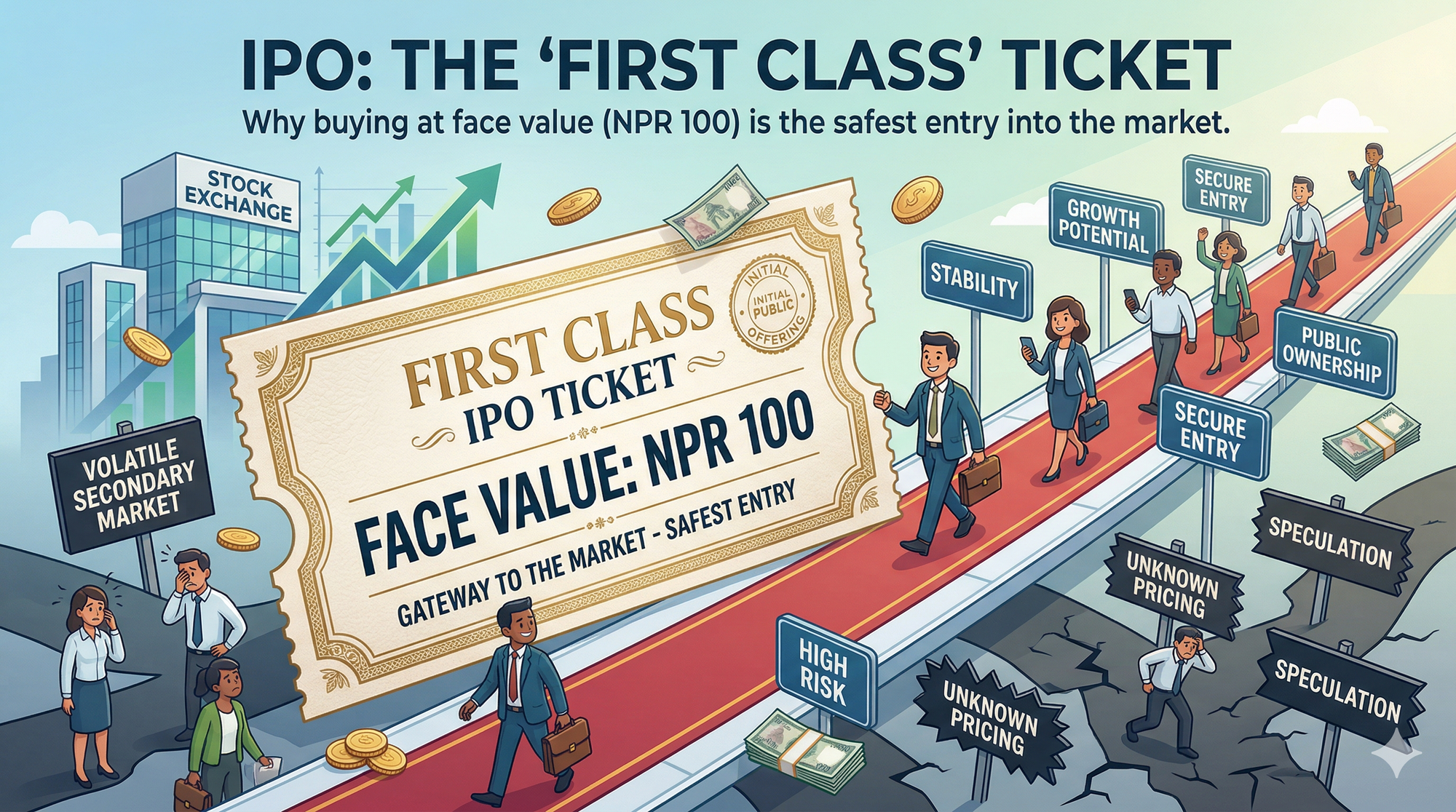
IPO: The "First Class" Ticket: Why buying at face value (NPR 100) is the safest entry into the market.
While everyone else pays premium prices for shares, IPO allottees board at NPR 100—the only seat on the plane guaranteed not to drop below the floor.
The Queue at 5 AM
If you've ever passed by a bank branch in Kathmandu on an IPO opening day, you've seen the spectacle. Hundreds of Nepalis—rickshaw drivers, office clerks, college students, retired grandparents—standing in line before sunrise, ASBA forms clutched in hand, hoping to get a piece of the action. Some apply through multiple bank accounts. Others pray to Manakamana for allotment luck.
To outsiders, this looks like gambling fever. But here's what the critics miss: An IPO is the only time in the share market where you buy at the absolute floor price. When a company goes public in Nepal, it issues shares at NPR 100 (or occasionally NPR 10 for microfinance). This is the face value—the accounting value of the share. Once trading begins, the price almost never returns to this level.
Think of it like buying a ticket for a Kathmandu-Delhi flight. The IPO price is the base fare. Once the flight takes off (listing day), the same seat trades at a premium in the secondary market. Everyone who bought early paid NPR 100. Everyone who boarded later pays NPR 150, NPR 200, or more. Who got the better deal?
The Mathematics of the NPR 100 Floor
Let's examine why this matters mathematically. In the secondary market, you buy shares from other investors who want to sell. The price reflects current sentiment, recent news, and market momentum. A share trading at NPR 500 could drop to NPR 300 if the company misses earnings or the market corrects. Your potential loss is real and immediate.
But at IPO, you buy directly from the company at NPR 100. The company receives your capital to expand operations—build a new hotel wing, install additional turbines, open rural branches. You are not trading paper with strangers; you are becoming a founding partner in the company's public journey. The NPR 100 price represents the company's book value, not market speculation.
Historical data from NEPSE tells a compelling story. Over the past decade, the vast majority of IPOs have listed at premiums ranging from 20% to 300% above the issue price. Even when the secondary market crashes, IPO shares rarely fall back to their original NPR 100 offering price. The floor holds because it reflects actual capital invested in real assets, not market euphoria.
Why IPOs Feel Like a Lottery (But Aren't)
Yes, IPO allocation in Nepal uses a lottery system because demand exceeds supply. Millions apply; only thousands receive shares. This random selection creates confusion. People think, "If getting shares depends on luck, this must be gambling."
This is where understanding the distinction between chance and risk becomes essential. The lottery determines who gets to buy at NPR 100. But once allotted, you hold a productive asset—not a betting slip. A lottery ticket has no underlying value; an IPO share represents ownership in a regulated, audited company with physical assets and revenue streams.
The gambling comparison only holds if you sell immediately for a quick profit and treat the market like a casino. But the wise investor—the one building long-term wealth—holds these NPR 100 shares for years, collecting dividends and watching the company grow. The "luck" of allotment is merely the entry ticket; the wealth comes from patience and business growth.
The Safety Profile: IPO vs. Secondary Market
Consider the risk comparison for a lower-middle-class Nepali investor with limited capital:
| Factor | IPO Investment (NPR 100) | Secondary Market Purchase |
|---|---|---|
| Entry Price | Face value (NPR 100) | Market price (NPR 150–500+) |
| Downside Risk | Limited; rarely falls below NPR 100 | Significant; can drop 30–50% in corrections |
| Company Information | Fresh audit, full prospectus disclosure | Variable; may require deeper research |
| Regulatory Oversight | SEBON approval required for issuance | Standard listing requirements |
| Capital Requirement | Minimum 10 shares (NPR 1,000) | Depends on market price (often higher) |
The table reveals why IPOs serve as the ideal entry point for new investors. The downside is mathematically capped because you're buying at the base accounting value. The company has a fresh regulatory review. The capital requirement is minimal—often just NPR 1,000 to NPR 10,000, amounts accessible even to lower-middle-class families saving from monthly budgets.
The Psychology of the "Safe" Bank Account
Many Nepali families hesitate to apply for IPOs because they view the share market as risky, preferring to keep money in savings accounts where the balance "never goes down." This perception is understandable but financially costly.
The hidden risk of savings accounts is inflation erosion. While your NPR 100,000 stays constant in number, its purchasing power declines 3–4% annually. Over five years, you've lost 15–20% in real terms—without ever seeing a red number on your statement.
Contrast this with IPO investing: Yes, the price fluctuates after listing. Yes, some IPOs underperform if the company struggles. But historically, diversified IPO portfolios in Nepal have delivered returns far exceeding inflation. The "risk" of temporary price declines is actually less damaging than the guaranteed loss from inflation in savings accounts.
The 2026 IPO Landscape in Nepal
The current market environment makes IPOs particularly attractive. As of 2026, Nepal's financial sector continues expanding into underserved areas. New microfinance institutions, regional banks, and insurance companies are going public to raise capital for reaching rural populations. These aren't speculative tech ventures; they are brick-and-mortar businesses with tangible collateral and regulated operations.
Additionally, the ASBA (Application Supported by Blocked Amount) system has made IPO applications seamless. You don't need to withdraw cash or visit multiple offices. Your bank blocks the application amount; if you don't get allotted, the money releases automatically. If you do get shares, the amount debits seamlessly. The process is now accessible to anyone with a bank account and internet access—including rural customers using mobile banking.
The Nagarik App and digital governance initiatives are further streamlining financial access. Soon, IPO applications may integrate directly with national digital ID systems, reducing paperwork and expanding participation to every corner of Nepal.
Strategy for the Small Investor
If you're a lower-middle-class Nepali looking to start your investment journey, here's a practical approach:
1. Apply for Every IPO — Don't try to pick winners. Apply to all SEBON-approved IPOs, especially in sectors you understand (banks, insurance, hydropower). The law of averages works in your favor; some will list at 50% premium, others at 200%. The allotment process is random, so maximize your chances by applying consistently.
2. Hold, Don't Flip — When allotted, resist the temptation to sell immediately for a quick 50% gain. That gain is taxable and eliminates your advantage. Instead, hold for the long term. Let the company pay dividends. Let the share price appreciate over years, not days.
3. Reinvest Dividends — When you receive dividend payments, use them to apply for more IPOs or buy additional shares in the secondary market of quality companies. Compound growth builds wealth; single transactions just provide momentary cash.
4. Build a Portfolio — Over time, aim to hold shares in 10–15 different companies across sectors. Start with IPOs to build your base at NPR 100, then diversify strategically in the secondary market once you understand how different sectors perform.
The Reality of Allotment Frustration
Let's be honest: Most IPO applications get rejected. The demand is simply too high. You might apply to ten IPOs and get allotted in only one or two. This frustrates many investors who then give up or turn to the secondary market out of impatience.
But this frustration is misplaced. Think of IPO applications like planting seeds. You don't expect every seed to sprout; you plant many knowing that enough will grow to feed your family. Each application costs nothing (the blocked amount earns interest while waiting). The only cost is a few minutes of your time. Persistency—not luck—determines long-term IPO success.
Meanwhile, every rejection protects you. If you had been allotted in every IPO, you might overextend financially. The selective allotment ensures you only receive shares when you genuinely have capital available, and it forces diversification across time and market conditions.