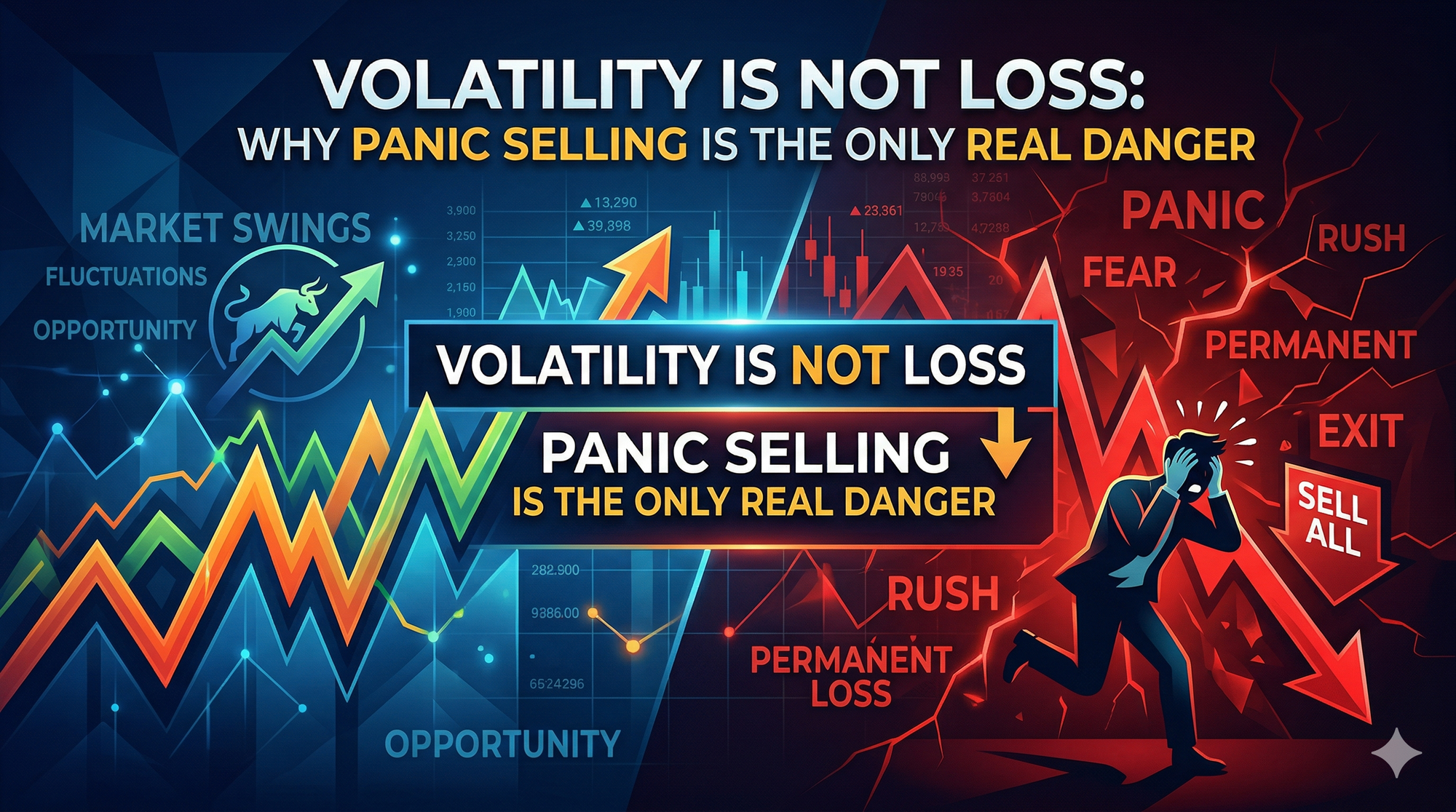
Volatility Is Not Loss: Why Panic Selling Is the Only Real Danger
The NEPSE index wiggles like a Kathmandu microbus in traffic—but unless you jump out mid-ride, you haven't actually lost anything.
The Felt Sense of "Losing Everything"
It's a Tuesday morning in April 2026. You open your Meroshare app with your morning tea, and your stomach drops. The NEPSE index has shed 200 points in three days. Your portfolio, which was showing a healthy 15% gain last month, is now down 8%. Your mind starts racing: "I knew this share market was gambling. I should have kept the money in my bank account. What if it keeps falling?"
You click "Sell All" before you finish your tea. The relief is immediate—no more anxiety, no more red numbers. Congratulations. You just turned a temporary paper decline into a permanent, real loss.
This is the tragedy playing out in thousands of Nepali households every time the market hiccups. We confuse volatility (the normal breathing of markets) with loss (the actual destruction of capital). And in that confusion, we make decisions that sabotage our financial futures.
Understanding What Volatility Actually Means
Volatility is simply the measure of how much prices move up and down over time. Think of it like the weather in Kathmandu during monsoon—unpredictable day-to-day, but following predictable seasonal patterns over months.
When you buy shares of a company—say, a commercial bank or a hydropower project listed on NEPSE—you are buying a piece of a real business. That business doesn't change its fundamental value hour-to-hour just because the ticker price fluctuates. The bank still has its branches. The hydropower dam still generates electricity. The employees still show up for work. The business is still there; only the market's mood has shifted.
Consider this: In 2022, NEPSE hit a high near 3,200, then crashed to nearly 1,800 by early 2023. Investors who panicked and sold at the bottom locked in massive losses. But those who held—or better yet, bought more during the panic—saw the index recover above 2,600 by 2026. The volatility was temporary; the loss was only real for those who sold.
The Psychology of Paper Losses
Humans are wired to feel losses more intensely than gains. Behavioral economists call this "loss aversion," and it is particularly cruel to new investors. When your portfolio shows a "loss" of NPR 50,000, your brain screams danger as if you physically lost that cash on the street.
But here's what your brain misses: You haven't lost anything until you sell. Those shares still represent ownership in productive companies. If the underlying businesses are sound—if banks are still lending, if hotels are still booking tourists, if telecoms are still adding subscribers—then the value is merely hiding, not gone.
This is where understanding the difference between investing and gambling becomes crucial. A gambler's bet expires worthless when the dice roll wrong. A business partner's stake fluctuates with market sentiment but retains underlying value as long as the business operates. When you treat NEPSE like a casino, every dip feels like a catastrophe. When you treat it like a partnership, dips become opportunities to acquire more ownership at discount prices.
Why Bank Accounts Feel Safe (But Steal Your Future)
Many Nepali investors, after experiencing their first market downturn, retreat to the "safety" of savings accounts. The balance never goes down. No volatility. No sleepless nights. Perfect, right?
Wrong. Your bank account is bleeding purchasing power every single day. With inflation hovering around 3.6% and savings accounts paying 2.8%, you are guaranteed to lose about 0.8% annually in real terms. Over a decade, that "safe" approach destroys more wealth than a temporary 20% market decline that eventually recovers.
Markets are volatile. Cash is certain—certain to lose value. The question isn't whether you can stomach volatility; it's whether you can afford the guaranteed erosion of savings.
The Mechanics of Real Loss vs. Paper Decline
Let's be precise about what actually constitutes a loss:
| Scenario | What Happened | Result |
|---|---|---|
| You buy 100 shares at NPR 500. Price drops to NPR 400. You hold. | Paper decline of NPR 10,000 | No loss realized. You still own 100 shares of the company. If price recovers to NPR 600 next year, you profit. |
| You buy 100 shares at NPR 500. Price drops to NPR 400. You sell. | Realized loss of NPR 10,000 | Permanent loss. You cannot recover. The money is gone. You locked in the decline. |
| You buy 100 shares at NPR 500. Company goes bankrupt. | Total loss of NPR 50,000 | Real loss. The business failed. This is why diversification matters. |
Notice that only two scenarios create actual, irreversible loss: selling into a decline, or total business failure. Volatility alone—the normal up-and-down movement—creates zero loss unless you react to it.
Lessons from the 2022-2023 NEPSE Crash
The recent market history offers perfect teaching material. When NEPSE collapsed from its highs, social media was flooded with stories of ruined investors. But look closer at who was actually ruined:
- The Margin Traders: Those who borrowed money to buy shares were forced to sell when prices fell (margin calls). They had no choice. This is why leverage turns volatility into loss.
- The Panic Sellers: Those who sold because they couldn't emotionally handle seeing red numbers. They chose to make temporary declines permanent.
- The Holders: Those who stayed invested, continued collecting dividends, and even bought more during the lows. They suffered paper declines but no real losses—and participated fully in the recovery.
The distinction is crucial. The market didn't destroy wealth; investor behavior did.
Building Immunity to Volatility
So how do you protect yourself from the panic that turns volatility into loss? Several practical strategies work specifically for Nepali investors:
1. Invest Only What You Don't Need Immediately — If you might need the cash for your sister's wedding next year, don't put it in shares. Volatility requires time to resolve. Money you need within 2-3 years belongs in fixed deposits or short-term instruments, not the stock market.
2. Diversify Across Sectors — Don't put everything into one "hot" hydropower stock. Spread across banks, insurance, hotels, and manufacturing. When one sector stumbles, others often hold steady.
3. Automate Your Investing — Use SIPs (Systematic Investment Plans) or regular monthly purchases. This removes emotion from the equation. When prices drop, your fixed amount buys more shares automatically. You learn to love volatility because it means acquiring assets at discount.
4. Stop Checking Prices Daily — If you're a long-term investor, daily price checks serve no purpose except to feed anxiety. Check quarterly, or when you have cash to invest. The business fundamentals change slowly; only the market's mood changes quickly.
The True Cost of Safety
Every time you sell into a panic to "preserve capital," you are making a trade. You trade temporary comfort for permanent loss of purchasing power. You trade the possibility of long-term wealth for the certainty of inflation erosion.
Consider the math: If you panic-sold NEPSE holdings at 1,800 in early 2023 and moved to a savings account paying 3%, you "avoided" further declines. But by 2026, with the index back above 2,600, you missed a 44% recovery while your cash lost 8-10% to inflation. The "safe" choice cost you 50%+ in real wealth.
This same principle applies to your career and income. Diversification and patience beat false safety every time. Whether in employment or investing, the appearance of security often masks the reality of gradual decline.
When Selling Is Actually Correct
To be fair, sometimes selling is the right move. But the decision should be based on fundamentals, not fear:
- The company's business model has deteriorated permanently (not just temporarily)
- You need the cash for a genuine emergency or planned expense
- You are rebalancing to maintain diversification (selling high, buying low elsewhere)
- You have reached your financial goal and are shifting to lower-risk assets
Notice what's missing from this list: "Because the price went down and I feel scared." That is never a valid reason. Price movements alone contain no information about future returns. A falling price simply means other investors are scared—it's an opportunity to buy their panic, not to join it.