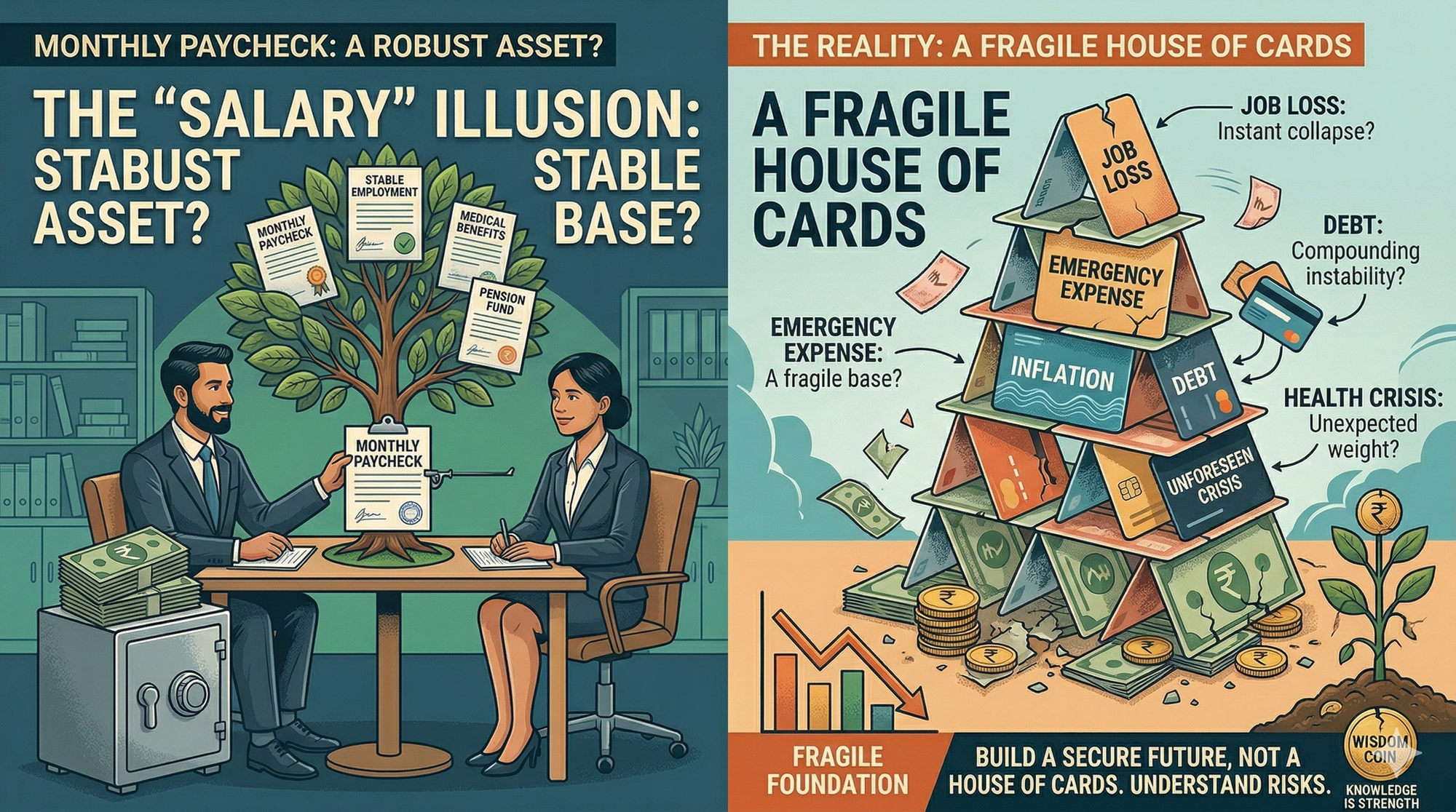
The "Salary" Illusion: Why Your Monthly Paycheck is a Fragile House of Cards
Why Nepali families are discovering that putting all their eggs in one employer's basket is the real financial danger—and how diversification beats the illusion of security.
The Kathmandu Office Illusion
Every morning, thousands of Nepali professionals squeeze into microbuses along the Ring Road, clutching their tiffins and their monthly salary hopes. They believe they've "made it"—a stable job at a bank, an NGO, or perhaps one of the telecom giants. The paycheck arrives on the 1st of every month like clockwork. This, they think, is safety.
But let's talk about what happened in 2023 when the NRB tightened monetary policies and suddenly, corporate restructuring became the buzzword from Thamel to Jhamsikhel. Friends I know—educated, experienced, "secure"—found themselves holding termination letters instead of Dashain bonuses. The "safe" job evaporated overnight.
Here's the uncomfortable truth: A single salary is not an asset. It's a dependency. And dependencies, as any farmer in the Terai will tell you after a failed monsoon, are dangerous.
The Math That Doesn't Lie
Let's break this down with actual numbers from 2026 Nepal. The average middle-class professional in Kathmandu earns roughly NPR 50,000–80,000 monthly. Sounds decent until you factor in:
| Expense Category | Monthly Cost (NPR) | Annual Inflation Impact |
|---|---|---|
| Rent (2BHK in Ring Road area) | 25,000–35,000 | +15% YoY |
| School fees (2 children, private) | 20,000–40,000 | +12% YoY |
| Groceries & utilities | 15,000–20,000 | +18% YoY |
| Transportation | 5,000–8,000 | Fuel price volatility |
Notice something? Your savings are bleeding value while your salary stays static. The "safe" job gives you a fixed income in an economy where nothing else is fixed. That's not stability—that's a slow-motion financial crisis.
The 10-Company Mindset: What It Actually Means
When I say "owning 10 different companies," I'm not suggesting you register 10 businesses at the Company Registrar's Office in Kathmandu and hire 500 employees. That's madness. What I mean is diversified income streams that behave like ownership stakes—each with its own risk profile, growth trajectory, and independence from your day job.
Consider a typical Nepali professional who decides to break the trap:
- Company 1: Their primary job (the "safe" one that might not be so safe)
- Company 2: A small agricultural investment back in their home village (coffee in Gulmi, ginger in Palpa, or dairy in Chitwan)
- Company 3: A modest portfolio on NEPSE, treating shares as business partnerships rather than lottery tickets
- Company 4: Freelance digital services—perhaps coding, graphic design, or content writing for international clients
- Company 5: A rental property or room leasing in the expanding urban corridors
- Company 6: A side hustle in e-commerce, leveraging platforms like Daraz or local Facebook marketplace groups
- Company 7: Skills monetization—teaching, consulting, or training in their professional expertise
- Company 8: Micro-investments in local SMEs or cooperatives
- Company 9: Digital assets—perhaps a monetized blog, YouTube channel, or online course about Nepali cuisine, language, or trekking expertise
- Company 10: A speculative but calculated bet—maybe digital assets, a small stake in a friend's startup, or emerging tech opportunities
Here's the magic: If "Company 1" (your job) fires you tomorrow, you've got nine other engines running. Some might be sputtering, some might be roaring, but you're not starting from zero. That's real safety.
Why Nepalis Are Perfectly Positioned for This
We have advantages that our parents' generation didn't. Nepal's IT outsourcing potential is exploding. A developer in Pokhara can earn in dollars while paying rent in rupees. A teacher in Butwal can run an online IELTS coaching business for students in Bangladesh and India. A farmer in Surkhet can sell organic produce directly to consumers in Kathmandu via WhatsApp groups.
The Nagarik App revolution is streamlining government processes. E-governance is finally reducing the bureaucratic nightmares that killed small businesses in the past. The infrastructure for diversification is being laid as we speak.
And let's not ignore the diaspora advantage. Overseas Nepali students are returning with skills, networks, and capital. They're not just remitting cash—they're contributing code, expertise, and global perspectives. This creates partnership opportunities that previous generations couldn't imagine.
The Psychological Shift: From Employee to Owner
The hardest part isn't financial—it's mental. We've been conditioned by our schools, our families, and our society to crave that "government job" or "bank job" stamp of approval. It's cultural. It's emotional. It's also obsolete.
When you own 10 micro-companies (even if some are tiny), your psychology changes. You stop begging for permission. You stop tolerating toxic managers because "I have no choice." You start seeing opportunities instead of obstacles. You become, in essence, unfireable.
This isn't about becoming a ruthless capitalist. It's about finding stillness in a chaotic economy. When your income is diversified, you can actually breathe. You can make decisions based on principle rather than panic. You can sleep at night knowing that if one stream dries up, the river still flows.
The "But I Don't Have Time" Excuse
I hear this constantly. "I'm already working 10 hours a day, plus traffic, plus family responsibilities. Where will I find time for 9 other companies?"
Fair question. Here's the answer: You don't build all 10 at once. You start with one additional stream. Maybe it's investing 5,000 rupees monthly in an index fund. Maybe it's spending 2 hours every Saturday learning digital skills that can be monetized. Maybe it's converting your hobby of photography into stock photo sales.
The goal isn't to work 100 hours a week. The goal is to make your existing time more valuable and to build systems that generate returns without your constant presence. A rental property doesn't need your daily attention. A well-researched stock portfolio doesn't require micromanagement. Technology and automation are making passive income more accessible than ever.
The Real Risk Calculation
Let's compare two scenarios over 10 years:
Person A: The "Safe" Salaried Employee. Earns NPR 60,000/month consistently. Gets annual raises of 5%. Saves 20% of income. Total dependence on one employer. After 10 years: approximately NPR 12–15 lakhs in savings (assuming no major emergencies, which is unrealistic).
Person B: The Diversified Owner. Primary job earns NPR 50,000/month. But they also have: a small rental generating NPR 8,000/month; a growing investment portfolio averaging 12% annual returns; a side consulting business bringing in NPR 15,000/month; and a digital product earning passive income. Some months, one stream underperforms. Some months, they all do well. Over 10 years: multiple income sources have compounded. Even if they lose the primary job, they're never at zero.
Who is really safer? The person with one point of failure, or the person with multiple safety nets?
The Nepal-Specific Opportunities in 2026
We're at a unique inflection point. Infrastructure projects are being discussed that could transform trade routes. Green energy initiatives are positioning Nepal as a potential tech hub. Smart city pilots in places like Ghodaghodi are opening new real estate and service markets.
Meanwhile, new data protection policies are creating compliance and consulting opportunities. Governance reforms are slowly making business easier. The person with diversified interests can dip a toe in all of these waters. The person with only a salary watches from the sidelines.
The Philosophical Underpinning
There's a deeper reason this matters. Ancient wisdom teaches us about non-attachment and the impermanence of all things. Clinging to a single job as your sole identity and security is a form of attachment that creates suffering when (not if) change comes.
Diversification isn't just financial strategy—it's a spiritual practice of non-attachment. It's acknowledging that no single employer, no single government, no single economy is permanent. By creating multiple pillars, you're practicing wisdom that our ancestors understood but our modern education forgot to teach.
And when enough of us diversify, we create citizen-powered economic resilience. We reduce dependence on gatekeepers. We build a Nepal where opportunity isn't concentrated in the hands of a few conglomerates but distributed among millions of micro-owners.