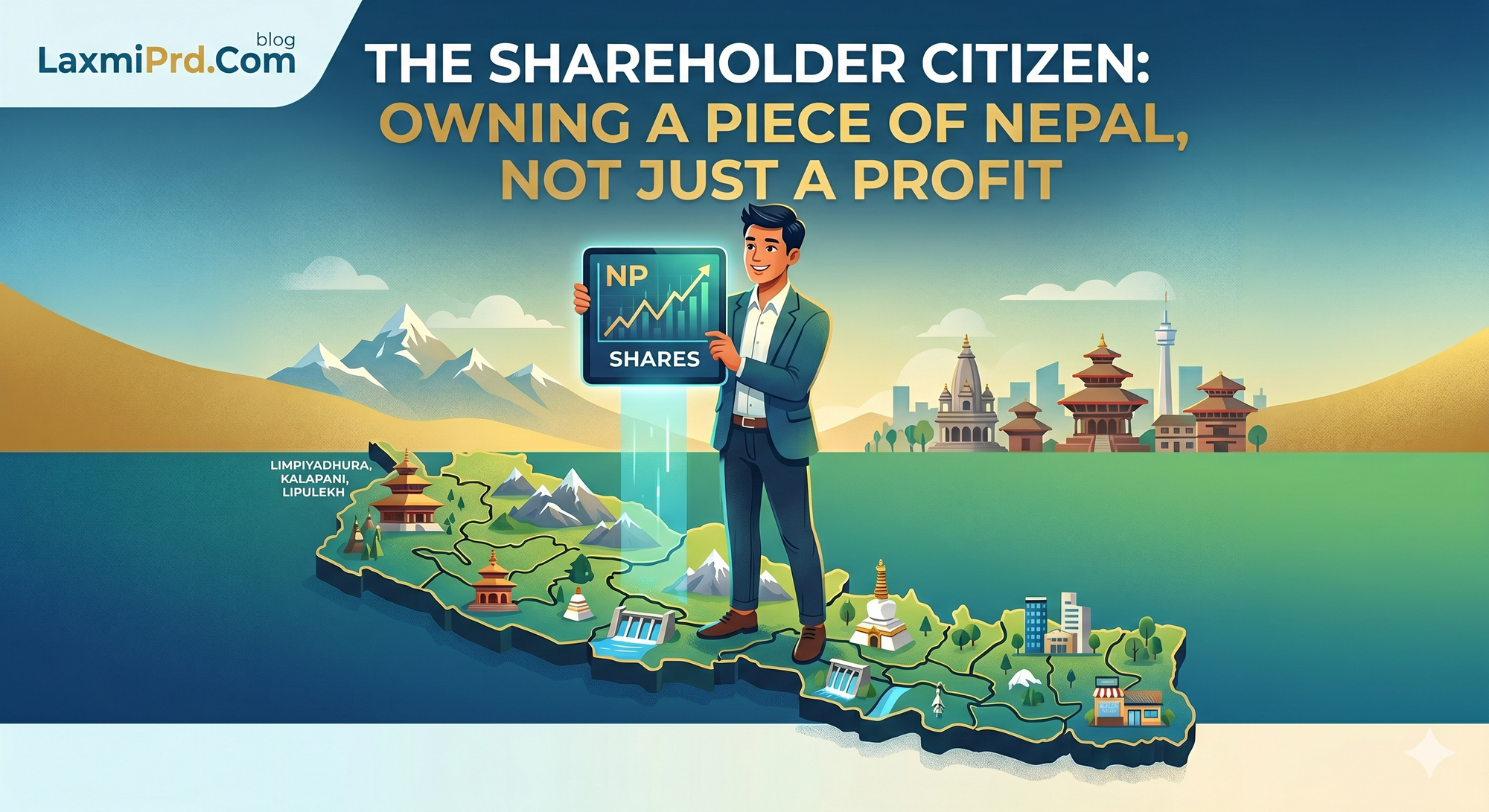
The Shareholder Citizen: Owning a Piece of Nepal, Not Just a Profit
Why applying for an IPO is not luck — it’s a responsibility toward national growth
In Nepal, the word “IPO” often creates excitement. People line up digitally, check MeroShare daily, and hope for “10 kitta paryo ki parena.” But here’s a truth that many overlook: buying an IPO is not just an opportunity to earn — it is a civic duty.
In a country like Nepal, where capital is scarce and development is uneven, every rupee invested into a company is not just personal finance — it is nation-building. When you hold shares, you are not just an investor. You become a silent partner in Nepal’s economic engine.
This shift in thinking is critical for 2026 Nepal, where the conversation must move from “quick profit” to “long-term ownership.”
IPO: Not a Lottery Ticket, but a National Contract
Let’s be honest — many Nepalis still treat IPOs like a lottery. Apply, get lucky, sell quickly, and exit. But this mindset limits both personal growth and national progress.
A shareholder is entering into a contract of trust with a company. That company could be a hydropower project in Dolakha, a microfinance in Terai, or a manufacturing unit in Biratnagar. Your investment allows them to build, expand, and operate.
As explained in this article on risk vs gambling in the share market, the stock market is fundamentally a partnership — not a game of chance.
So the real question is: Are you gambling with IPOs, or are you building Nepal?
Why Shareholders Matter More in Nepal Than in Developed Countries
In countries like Australia, companies have multiple funding options — venture capital, private equity, large institutional investors. But Nepal is different.
Here, citizens themselves are the backbone of capital formation.
Institutions like Nepal Rastra Bank (NRB) regulate financial systems, and NEPSE facilitates trading — but the real power lies in everyday people investing NPR 10,000, NPR 20,000, or even NPR 100,000.
That money builds:
- Hydropower plants that reduce load-shedding
- Road infrastructure that connects remote districts
- Banks that fund SMEs and local businesses
In short, your IPO application is a vote for Nepal’s future.
The Civic Duty of Holding, Not Just Selling
One of the biggest problems in Nepal’s stock culture is early selling. As soon as shares are listed and price rises, many investors exit immediately.
This creates instability.
Imagine if every citizen sold their shares instantly — companies would struggle to maintain value, long-term projects would weaken, and market trust would decline.
Holding shares is not just a financial strategy. It is a civic act of stability.
It signals confidence. It allows companies to plan long-term. It strengthens Nepal’s economic foundation.
This idea connects deeply with long-term thinking discussed in building a 10-year financial vision, where wealth is created through patience, not panic.
IPO Investment vs Bank Saving: A Silent Reality
Many lower-middle-class families in Nepal still prefer saving money in banks. It feels safe. Predictable. Comfortable.
But here’s the hidden reality:
| Aspect | Bank Saving | IPO Investment |
|---|---|---|
| Return | Low (often below inflation) | Potentially higher |
| Impact | Limited | Direct national growth |
| Ownership | None | You own a company stake |
As explored in the hidden risk of saving, money sitting idle often loses value over time.
Meanwhile, IPO investment — when done wisely — puts your money to work for both you and the country.
From Citizen to Owner: A Mindset Shift Nepal Needs
In Nepal, we often complain about poor infrastructure, slow development, or lack of opportunities. But rarely do we ask:
“Am I participating in building the solution?”
IPO participation is one of the simplest ways for a common citizen to contribute.
You don’t need political power. You don’t need to be rich. You just need awareness.
Even a small investment means:
- You are funding real projects
- You are sharing risk and reward
- You are becoming part of Nepal’s growth story
This aligns closely with broader ideas of citizen participation in governance and development, like those discussed in citizen-powered governance.
The Lower-Middle-Class Advantage (Yes, Advantage)
Interestingly, Nepal’s IPO system gives a unique advantage to lower-middle-class citizens.
Through policies like reserved quotas and fair allotment systems, even small investors get access to ownership opportunities that would be impossible in many countries.
This means:
- A farmer in Kailali
- A student in Kathmandu
- A worker in Australia sending remittance
— all have the same entry price (NPR 100 face value) for many IPOs.
This is economic democracy in action.
But democracy only works when citizens act responsibly.
So What Does “Responsible Shareholding” Look Like?
Being a responsible shareholder in Nepal is simple, but powerful:
- Understand the company before applying
- Avoid panic selling for short-term gains
- Think long-term (3–10 years horizon)
- Stay informed about company performance
- Encourage others to invest wisely
It’s not about becoming a finance expert overnight. It’s about changing intention — from quick profit to meaningful participation.
A 2026 Reality Check: Nepal Needs Its Shareholders
Nepal stands at a critical point in 2026.
Major infrastructure ideas — from hydropower expansion to projects like the Seti Corridor — require massive funding. The government alone cannot do it.
Foreign investment comes with conditions.
But citizen investment? That builds both ownership and sovereignty.
If millions of Nepalis start treating IPOs as civic duty, not just opportunity, the impact could be transformational.
Source reference: :contentReference[oaicite:0]{index=0}