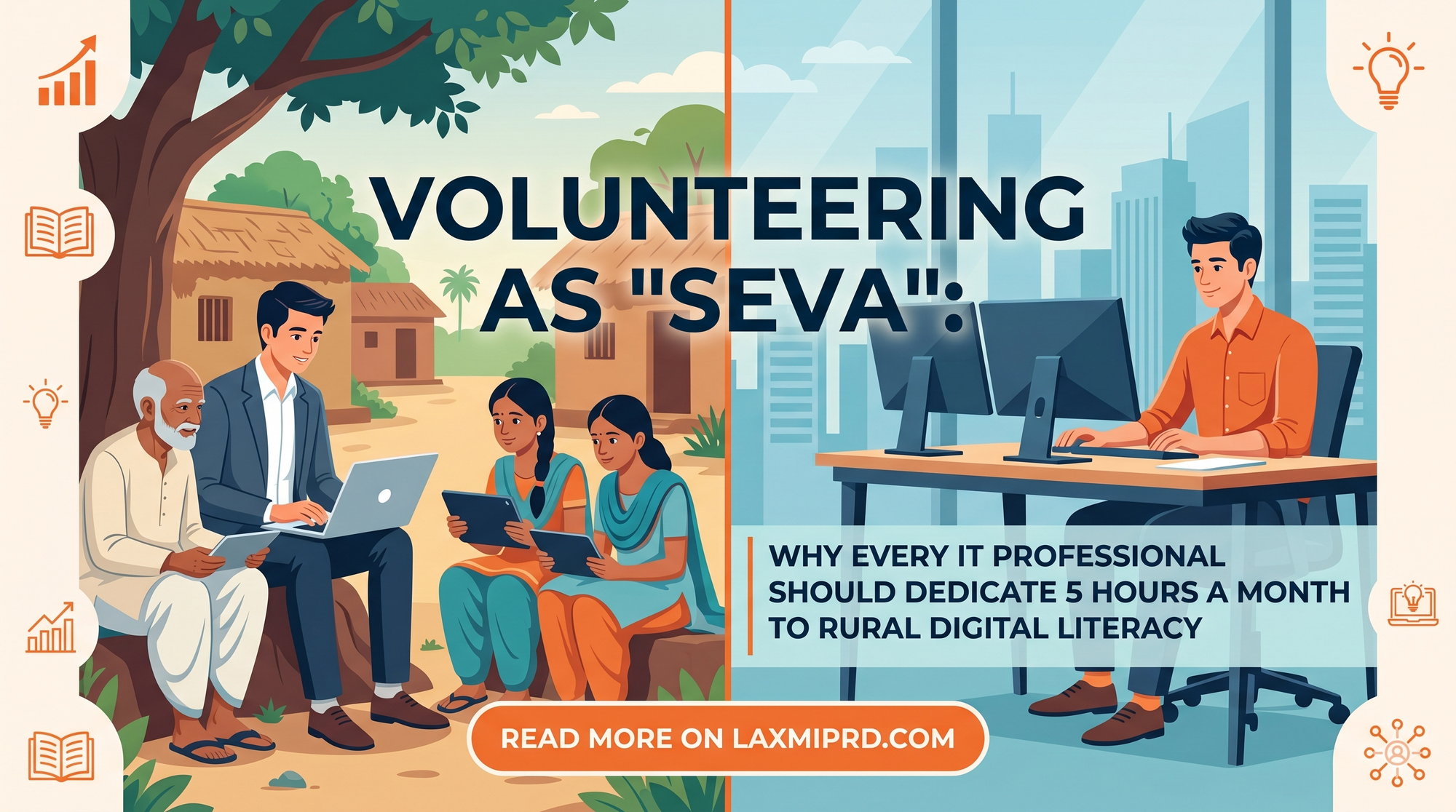
From Code to Community: Why ‘Seva’ Might Be Nepal’s Most Powerful Tech Stack
How 5 hours a month from IT professionals can quietly reshape rural Nepal’s digital future
In Nepal, we’ve always understood Seva not as charity, but as responsibility. It’s what we do without being asked — helping a neighbour, supporting a community, building something bigger than ourselves.
Now fast forward to 2026. Nepal is digitising rapidly — Nagarik App integrations, NEPSE going more tech-driven, NRB pushing digital payments. But there’s one uncomfortable truth: rural Nepal is still catching up.
That’s where IT professionals come in.
Not with massive funding. Not with government contracts.
Just 5 hours a month.
Sounds small? Let’s unpack why it’s not.
The Digital Divide Isn’t Just About Internet — It’s About Understanding
Walk into a rural municipality in Karnali or Sudurpaschim, and you’ll see something interesting. Many people now have smartphones. Some even have 4G access.
But:
- They don’t trust online banking
- They fear scams (often rightly)
- They don’t know how to apply for government services digitally
- Students use YouTube — but not for learning
This is not an infrastructure problem anymore. It’s a digital literacy problem.
If you’ve read Digital Literacy in Rural Nepal: A Strategy for Bridging the Gap, you’ll know the issue isn’t access — it’s guidance.
And guidance doesn’t need billions. It needs people.
Why IT Professionals Are the Missing Link
If you work in IT — developer, analyst, QA, cloud engineer — you already possess something incredibly rare in Nepal:
Applied digital thinking
You don’t just use technology — you understand it.
That makes you more valuable than any policy document.
Think about this:
| Rural Need | What You Can Do (in 5 hrs) |
|---|---|
| Online payment confusion | Teach how to use eSewa/Khalti safely |
| Government form delays | Show how to use Nagarik App |
| Job search struggles | Guide on LinkedIn / CV creation |
| Students lack direction | Introduce free coding resources |
No fancy tools. No funding.
Just knowledge transfer.
5 Hours a Month = National-Level Impact (Seriously)
Let’s do a quick reality check.
- If 10,000 Nepali IT professionals contribute 5 hours/month → that’s 50,000 hours
- That’s equivalent to over 280 full-time workers — every single month
And here’s the twist: this workforce doesn’t need salaries, offices, or bureaucracy.
It’s decentralised. It’s flexible. It’s scalable.
This is exactly the kind of citizen-driven model discussed in The Diaspora’s Role: Contribute Code, Not Just Cash.
Because real development isn’t always top-down. Sometimes, it’s quietly peer-to-peer.
What ‘Seva’ Looks Like in a Digital Age
Forget the old image of volunteering.
This is what modern Seva looks like for IT professionals:
1. Weekend Zoom Classes
Teach basic digital skills to a group in your home district.
2. WhatsApp Support Groups
Help locals troubleshoot issues — from app installs to scams.
3. Local School Partnerships
Run short digital bootcamps during holidays.
4. Micro-Content Creation
Create simple Nepali tutorials on TikTok or YouTube.
5. Municipality Collaboration
Guide local governments on basic digital workflows.
This aligns strongly with ideas from The Brain Gain Blueprint, where even small technical inputs can modernise entire systems.
Why This Matters More in 2026 Than Ever Before
Nepal is at a strange but exciting crossroads.
- Digital banking is rising
- E-governance is expanding
- Remote work is becoming normal
But without digital literacy, these opportunities become risks.
For example:
- People fall for online scams
- They avoid digital services entirely
- They miss economic opportunities
If you’ve read How to Avoid Online Financial Scams, you’ll realise how vulnerable first-time users are.
So the question is simple:
Who will guide them?
The Hidden Personal Benefit (Yes, There Is One)
Let’s be honest — people are busy.
So here’s the part nobody talks about enough.
Volunteering doesn’t just help others. It sharpens you.
- You improve communication skills
- You learn to explain complex ideas simply
- You reconnect with Nepal’s real problems
- You build purpose beyond salary
In a world where many IT professionals feel stuck in repetitive work, this becomes something deeper.
Call it perspective. Call it grounding.
Or simply call it meaning.
A Simple Starting Plan (No Overthinking Required)
You don’t need a big plan. Start small.
| Week | Action |
|---|---|
| Week 1 | Identify a village/school/community |
| Week 2 | Prepare 1 simple topic (e.g., mobile banking) |
| Week 3 | Conduct a 1-hour session |
| Week 4 | Follow up and answer questions |
That’s it.
You’ve already contributed more than most policies ever will.