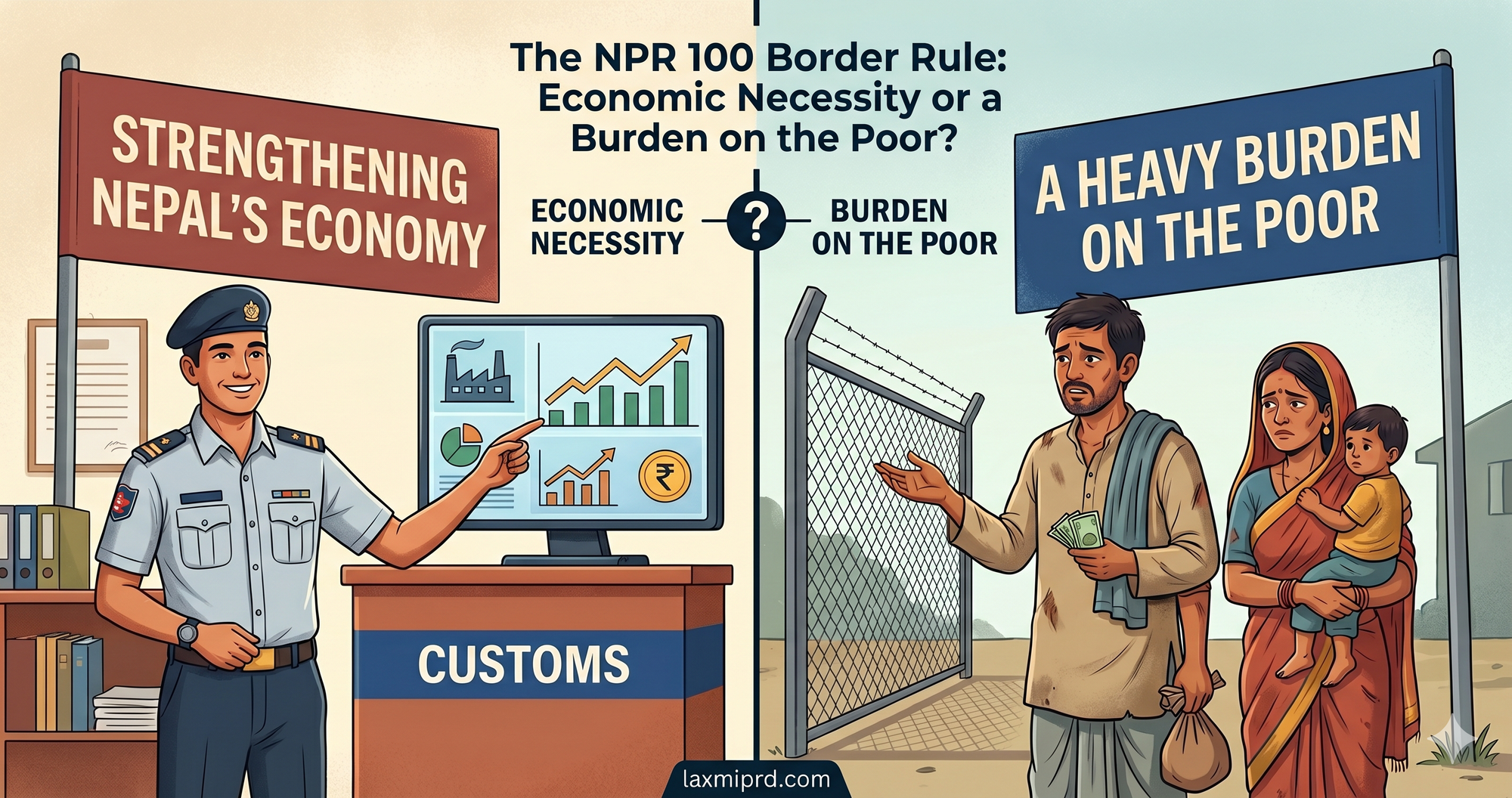
The NPR 100 Border Rule: Economic Necessity or a Burden on the Poor?
3 min read
When survival meets regulation in Nepal’s border economy
⚖️ The Government’s Perspective: Fixing a Leaky System
From the government’s viewpoint, the rule isn’t new—it’s just finally being enforced properly. Officials argue that Nepal has been losing millions in tax revenue due to informal trade practices along the India-Nepal border. Let’s break down their logic:- Revenue Leakage: Smugglers reportedly exploit loopholes by using multiple individuals to carry goods worth NPR 100 each, bypassing customs duties.
- Protection of Local Businesses: Shop owners in places like Dhangadhi and Birgunj struggle to compete with cheaper Indian goods.
- Digital Nepal Vision: The long-term goal is to move trade into a formal, trackable system aligned with Nepal’s digital transformation.
🔴 Ground Reality: When Policy Meets Poverty
While the intention might sound reasonable, the execution tells a different story. Let’s be honest—NPR 100 in 2026 is almost meaningless.| Item | Approx Cost (NPR) |
|---|---|
| 2 Liters Milk | 120–140 |
| Basic Vegetables | 150+ |
| Cooking Oil (1L) | 250+ |
🌏 Cultural and Social Impact
Nepal and India share more than just an open border—they share deep cultural ties. The concept of “Roti-Beti” relationships reflects generations of interlinked families. When a mother brings back a bag of vegetables from her relatives across the border, taxing that feels less like regulation and more like a disruption of social harmony. This is why many local leaders have labeled the enforcement as “administrative excess.”📉 Economic Impact: Who Really Pays the Price?
The reality is simple: policies like this often hit the lower-middle class the hardest. People who:- Earn daily wages
- Have no savings buffer
- Depend on price differences to manage household budgets
🧠 A Smarter Approach: The Case for a Tiered System
Here’s where the conversation gets interesting. Instead of a blanket rule, what if Nepal adopted a tiered customs system?| Category | Limit | Policy |
|---|---|---|
| Personal Use | Up to NPR 5,000 | Duty-Free |
| Semi-Commercial | NPR 5,000–20,000 | Low Tax |
| Commercial | Above NPR 20,000 | Full Customs Duty |
- Protect poor households
- Still capture revenue from actual traders
- Reduce corruption and friction at checkpoints
📊 Bigger Picture: Policy vs Practicality
Nepal is at a critical stage of economic transformation. From NEPSE market growth to digital governance initiatives, the country is trying to modernize rapidly. But policies must match ground realities. A law is only effective if:- People can realistically follow it
- It doesn’t punish survival behavior
- It builds trust—not resentment
🎥 What’s Happening on the Ground?
Protests have already begun in several border regions, especially Birgunj. For a detailed visual breakdown of the situation, you can watch this report: 👉 End of duty-free shopping? Nepal’s customs rule explained The footage shows how deeply this issue is affecting everyday citizens—not just traders.💬 The Real Question: Who Is This Policy For?
At its core, this debate isn’t just about customs or taxes. It’s about fairness. Should a mother buying groceries be treated the same as a smuggler? Should policy prioritize:- Revenue collection?
- Market protection?
- Or human survival?
📌 My Take
The government is not wrong in trying to control smuggling and formalize trade. But the method matters. A blanket NPR 100 rule in 2026:- Ignores inflation
- Disrupts cultural norms
- Places unfair pressure on the poor